


A basement floor must first survive the concrete slab beneath it. Concrete below grade constantly releases moisture vapour, and any covering that traps that vapour will eventually peel, cup, or develop mould. The best basement floor covering is therefore the one that handles slab moisture well, not simply the one that looks best in a showroom. This guide compares five vinyl coverings that suit basement use in different ways.
Rigid-core planks float over a vapour barrier, peel-and-stick tiles suit dry feature zones, and roll goods cover a room quickly with few seams. Each format has a clear moisture limit, and knowing that limit matters more than choosing a colour or pattern. Before you buy anything, test your slab with the simple plastic-sheet method described below. A dry slab opens up the whole list, while a damp slab narrows your choice to floating products.
Quick Verdict
Best Overall: SPC Rigid Core Click-Lock Plank, 5 mm, for whole finished basements that need a waterproof floating floor.
Best Budget: Livelynine Reclaimed-Wood Roll, for small accent zones, patches, and corners where a full room product is unnecessary.
Best Premium Look: VallisCo Wood-Look Planks, for a convincing timber appearance across a full family room floor.
Quick Comparison Table
| Product | Best For | Key Feature | Price |
|---|---|---|---|
| SPC Click Lock Luxury Vinyl Flooring Plank | Best Overall | Waterproof rigid Spc core, floating click-lock install | Check Price on Amazon |
| Art3d 36-Pack Peel and Stick Vinyl Floor | Best Featured-Area Tile | 54 sq ft, stone look, self-adhesive tiles | Check Price on Amazon |
| VallisCo Peel and Stick Vinyl Flooring, Wood | Best Full-Room Wood Look | 54 sq ft, textured wood grain planks | Check Price on Amazon |
| Oxdigi Vinyl Flooring Roll, 53 sq ft | Best Roll Goods | 53 sq ft continuous sheet, tape-down or loose-lay | Check Price on Amazon |
| Livelynine Reclaimed Wood Vinyl Flooring Roll | Best Small-Budget Patch | Narrow peel-and-stick roll for small areas | Check Price on Amazon |
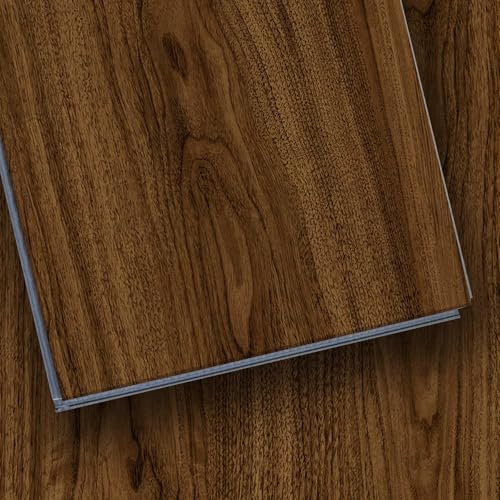
1. SPC Click Lock Luxury Vinyl Flooring Plank, 5 mm Rigid Core — Best Overall
 Check On The Amazon.com
Disclosure: As an Amazon Associate, I earn from qualifying purchases.
| Surface | Ultra-Durable & Pet-Friendly: With a 0.3mm wear layer tested over 15,000 abrasion cycles, this luxury vinyl plank flooring resists scratches, dents |
| Feature | 100% Waterproof Rigid Core Construction: Built with a 3.2mm sturdy Spc core (a dense mix of Pvc and limestone), this flooring is completely |
| Type | Easy Click Lock Installation & Stability: The innovative click-lock system allows for a effortless, glue-free installation that locks tightly |
✅ Reasons to buy
- Ultra-Durable & Pet-Friendly: With a 0.3mm wear layer tested over 15,000 abrasion cycles, this luxury vinyl plank flooring resists scratches, dents
- Easy Click Lock Installation & Stability: The innovative click-lock system allows for a effortless, glue-free installation that locks tightly
- 100% Waterproof Rigid Core Construction: Built with a 3.2mm sturdy Spc core (a dense mix of Pvc and limestone), this flooring is completely
- Built-in Sound Absorption & Comfort Underfoot: Enjoy a quieter home with the attached 1.0mm Ixpe underlay. It reduces footstep noise by 18-54 dB
❌ Reasons to avoid
- The main drawback is cold underfoot, since rigid vinyl over bare concrete feels hard and chilly without help.
SPC stands for stone plastic composite, and its limestone-filled core barely moves when slab vapour pushes against it. That stability is exactly what a basement needs, because seasonal moisture changes can cup softer vinyl cores and open joints over time. The click-lock planks float over a vapour barrier, so the floor can be lifted later if the slab ever misbehaves.
The main drawback is cold underfoot, since rigid vinyl over bare concrete feels hard and chilly without help. A good foam underlayment solves most of that problem while also serving as the vapour layer the system needs. This is the most substantial option on this list, and for a daily-use basement room, that extra specification is worth having.
2. Art3d 36-Pack Peel and Stick Vinyl Floor Tiles, Brown Stone — Best Featured-Area Tile
 Check On The Amazon.com
Disclosure: As an Amazon Associate, I earn from qualifying purchases.
| Surface | Stylish – Authentic wood looking and grain texture, adding timeless features to your home |
| Type | Easy Diy – Just peel and stick down on a flat floor for installation, no power tools, no experience, no glue, no accessories |
| Feature | Superior Property – Rigid surface and hard core, 100% waterproof, fire proof, wear resistant, scratch and abrasion resistant, high strength, no |
✅ Reasons to buy
- Easy Diy – Just peel and stick down on a flat floor for installation, no power tools, no experience, no glue, no accessories
- Stylish – Authentic wood looking and grain texture, adding timeless features to your home
- Superior Property – Rigid surface and hard core, 100% waterproof, fire proof, wear resistant, scratch and abrasion resistant, high strength, no
- Wide Application – Besides as flooring, it can be applied to wall, ceiling, cabinet by adding extra glue (liquid nail)
❌ Reasons to avoid
- Skip it if you need one product to cover every floor type in the house.
These peel-and-stick tiles suit a dry basement zone that needs a finished look without a full plank installation. The stone-look pattern forgives imperfect concrete well, because the varied surface hides small cracks and patches that a plain floor would show. Installation needs little more than a knife and a straight edge, and a single damaged tile can be replaced without disturbing the rest.
The honest limit is the adhesive bond itself, since it sticks directly to the slab and vapour underneath will lift it. This makes the plastic-sheet test essential before you commit to any stick-down product in a basement. For a verified-dry feature area, however, this is a convincing and affordable way to finish a corner, landing, or laundry zone.
3. VallisCo Peel and Stick Vinyl Flooring, Wood Look, 36 Pack — Best Full-Room Wood Look
 Check On The Amazon.com
Disclosure: As an Amazon Associate, I earn from qualifying purchases.
| Feature | Coverage, Dimensions & Loss Factor Guide – Includes 36 precision-cut planks per box, each measuring 36" x 6" with a 0.08" solid thickness, covering |
| Surface | Commercial-Grade Wear Resistance – Engineered with a heavy-duty protective wear layer over a high-density 0.08" thick vinyl core, providing |
| Formula | Rental-Friendly & Residue-Free Removal – Pre-applied with a commercial pressure-sensitive adhesive that bonds firmly to clean, flat, and dry |
✅ Reasons to buy
- Rental-Friendly & Residue-Free Removal – Pre-applied with a commercial pressure-sensitive adhesive that bonds firmly to clean, flat, and dry
- Textured Wood Grain & Anti-Slip Safety – Crafted with a 3D embossed, tactile wood grain surface that accurately replicates natural hardwood texture
- Impermeable Waterproofing & Easy Maintenance – Non-porous vinyl composite structure completely repels spills, standing water, and household stains.
- Coverage, Dimensions & Loss Factor Guide – Includes 36 precision-cut planks per box, each measuring 36" x 6" with a 0.08" solid thickness, covering
❌ Reasons to avoid
- Skip it if you need one product to cover every floor type in the house.
This wood-look plank set gives a family room basement the warmth of timber without the moisture risk of real wood. The textured grain and random plank lengths read as genuine boards from normal standing height, and the scratch-resistant surface handles everyday basement foot traffic well. With 54 square feet per pack, it can cover a full room when you buy enough packs for the space.
Preparation decides the result more than the product itself, because adhesive bonds to dust just as readily as it bonds to concrete. Scrub the slab, vacuum it thoroughly, and wipe it clean before you lay the first plank. On a dry, well-prepared slab, this is the most convincing timber look among the stick-down options on this list.
4. Oxdigi Vinyl Flooring Roll, 53 sq ft — Best Roll Goods
 Check On The Amazon.com
Disclosure: As an Amazon Associate, I earn from qualifying purchases.
| Surface | Effortless installation: Experience a hassle-free setup with our vinyl flooring roll. This luxury vinyl flooring includes special adhesive tape |
| Formula | Cost-Effective solution: Choose our roll vinyl flooring for an affordable yet stylish option. These vinyl floor rolls provide a budget-friendly |
| Use | Follow the label dose for best results |
✅ Reasons to buy
- Durable pvc material: Our vinyl flooring rolls are made from high-quality Pvc, making them waterproof, easy to clean, and removable. These vinyl
- Cost-Effective solution: Choose our roll vinyl flooring for an affordable yet stylish option. These vinyl floor rolls provide a budget-friendly
- Effortless installation: Experience a hassle-free setup with our vinyl flooring roll. This luxury vinyl flooring includes special adhesive tape
- Suitable for all grounds: This vinyl flooring roll is compatible with all types of ground surfaces, including cement. It is not picky about the
❌ Reasons to avoid
- Skip it if you need one product to cover every floor type in the house.
Roll goods solve the basement seam problem from the opposite direction to planks and tiles. One continuous sheet has no joints for moisture to exploit, and it can loose-lay over a dry slab without any adhesive at all. That reversibility is a real advantage in a basement, because you can lift the sheet if damp appears and deal with the slab directly.
The trade-off is width, since rooms wider than the roll need a joined seam and careful taping. Flexible sheet vinyl can also dent under heavy point loads, such as furniture feet left in one place for years. For a fast, reversible whole-room floor that can be finished in a weekend, though, no other format on this list is as quick.
5. Livelynine Reclaimed Wood Vinyl Flooring Roll — Best Small-Budget Patch
 Check On The Amazon.com
Disclosure: As an Amazon Associate, I earn from qualifying purchases.
| Surface | Details: 15.8×78.8 Inch, total 8.65 sq.ft (40cmX2m) Made of durable thin vinyl, thickness: 0.015 In (0.4MM). Peel and stick wood planks vinyl |
| Type | Diy freely: Trimming gridlines on backing paper for precise measurements, cut to any sizes, peel and stick on any smooth flooring or furniture. |
| Use | Follow the label dose for best results |
✅ Reasons to buy
- Details: 15.8×78.8 Inch, total 8.65 sq.ft (40cmX2m) Made of durable thin vinyl, thickness: 0.015 In (0.4MM). Peel and stick wood planks vinyl
- Diy freely: Trimming gridlines on backing paper for precise measurements, cut to any sizes, peel and stick on any smooth flooring or furniture.
- All-Purpose: Contact paper for floors, vinyl flooring roll for floors, peel and stick wood planks for walls, peel and stick flooring for bathroom
- Waterproof: The floor wallpaper is made of Pvc Vinyl on top, the vinyl can’t form hydrogen bonds with water molecules. Even if it comes in contact
❌ Reasons to avoid
- Skip it if you need one product to cover every floor type in the house.
Not every basement job is a whole room, and this narrow roll exists for the smaller jobs that other products overcomplicate. It suits a laundry corner, a step landing, a runner strip, or a patch where an old covering has failed. The reclaimed-wood look gives a small zone a finished appearance, and the roll cuts easily around posts, sump lids, and cleanouts.
The wear surface is thin, so this roll suits light-duty zones rather than a busy family room floor. Treat it as an accent and repair product, not as a room solution, and it will do its job well. For the stubborn corner that no full-size product can justify, this is the piece that finishes the floor neatly.
How to Choose Basement Floor Covering
Start With the Plastic-Sheet Test
Tape a two-foot square of clear plastic to the slab, seal all four edges tightly, and wait a full day before checking underneath. Droplets or dark damp patches under the plastic mean vapour is moving through the concrete, and every adhesive product on this list should then leave your shortlist. A dry result means the whole list is open, including the lower-cost stick-down routes that a damp slab would ruin.
Repeat the test in the dampest corner of the room. Slabs vary from one area to another, and one dry spot proves nothing about the rest. If your basement has a history of visible damp or standing water, no floor covering will fix the slab itself. Fix drainage, gutters, and grading first, and treat the floor covering as the final step rather than the cure.
Floating Beats Glued Below Grade
A floating floor sits on a vapour barrier and can be lifted when the slab misbehaves, which is a courtesy that glued products simply cannot extend. Rigid-core click-lock planks float freely, so they survive seasonal movement that cracks bonded installations and peels stick-down tiles. Below grade, the ability to un-lay a floor is a genuine feature, not just a convenience for future remodelling.
Glued and stick-down products bond vapour pressure directly into their own failure mode, because trapped moisture pushes against the adhesive until it releases. On a verified-dry slab they can perform well for years, and the plastic-sheet test is what verifies that dryness honestly. Skipping that step turns any adhesive choice into a slow peel that was predictable from the first day.
Underlayment Is Where Comfort Comes From
Concrete is cold and hard, and the floor covering above it inherits both traits unless something softens the layer between them. A foam underlayment under floating planks adds warmth underfoot, deadens footstep sound, and works as the vapour layer in one simple roll. Our underlayment guide for vinyl plank flooring compares the options that pair best with rigid-core planks in basements.
Peel-and-stick and roll goods sit much thinner, so their rooms feel colder unless you add rugs in the sitting zones. The combination of a thin covering plus rugs suits a casual rec room well, while a proper underlayment suits a basement used daily as living space. Your feet will grade this decision every single day, so it deserves more attention than the pattern choice.
Match the Format to the Room
Choose rigid-core planks for a whole finished basement used daily. They offer the best balance of moisture resistance, durability, and reversibility. Choose peel-and-stick tiles or planks for a dry feature zone or a rental. They let you change the look later without a major demolition job. Choose a roll for the fastest reversible coverage, especially when you need a usable floor by the end of a weekend.
Think about furniture and traffic before you decide, since heavy point loads dent flexible sheets while rigid planks spread weight more evenly. Think about future access too, because sumps, cleanouts, and drain covers need a floor that can be cut or lifted around them. A floor that looks perfect but blocks access to a sump pump is a problem waiting for a wet day.
What Never Goes Below Grade
Solid hardwood and standard laminate both fail in basements in the same predictable way. Their cores absorb slab vapour and then cup, swell, or buckle beyond repair. Bamboo behaves in much the same way, and no installation trick reliably reverses that damage once it starts. Carpet can work only with a vapour-barrier underlayment and a dehumidifier running nearby. It remains the first thing a damp basement will saturate.
Every product family on this list is synthetic on purpose, because below grade rewards waterproof choices over natural materials every time. If you were hoping for real timber character, vinyl with a textured grain is the honest compromise that survives the slab. Measure your room carefully before ordering, add allowance for cuts and waste, and keep a few spare planks or tiles for future repairs.
Frequently Asked Questions
What is the most moisture-proof basement flooring?
Rigid-core vinyl, known as SPC, over a vapour-barrier underlayment is the most moisture-proof practical choice for a basement. The core barely moves with slab humidity, and the floating installation keeps the vapour barrier continuous beneath the whole floor. Sheet vinyl is equally waterproof as a material, but it is thinner underfoot and dents more easily under furniture.
Can I put vinyl plank directly on concrete?
Yes, you can put vinyl plank on concrete, provided floating planks sit over a vapour-barrier underlayment first. Stick-down planks and tiles need a slab that passes the plastic-sheet test, because adhesive laid on a damp slab will eventually release. Skipping the barrier or the test is the most common reason vinyl fails in a basement.
Is peel-and-stick tile good for basements?
On a dry slab, peel-and-stick tile is good for basements and offers one of the simplest finished looks available. On a slab with any vapour movement, adhesive tiles tend to lift within months, starting at edges and seams. The plastic-sheet test makes the decision unemotional, because it tells you whether your slab is dry enough before you spend anything.
How do I stop my basement floor from being cold?
A foam underlayment beneath floating plank is the biggest single improvement, because it insulates the floor from the cold concrete slab. Add rugs in the sitting zones as well, since they warm the exact spots where bare feet land most often. Together, underlayment and rugs can change how a basement feels within a day of installation.
Do I need a subfloor in a basement?
Vinyl products do not need a raised subfloor, because they float happily over a barrier and slab combination. Raised subfloor panels remain useful for carpet or engineered wood, and for basements with a known damp history that wants extra separation from the slab. For most vinyl basement floors, a good underlayment gives you the comfort without the height and cost of a full subfloor.
Can I use engineered wood in a basement?
Engineered wood is riskier than vinyl below grade, because even a sealed installation can suffer if slab moisture finds a seam or edge. Some rigid-core engineered products perform better than others, but vinyl remains the safer default for most basement rooms. Our engineered wood flooring review explains how those products are rated, so you can judge the risk before choosing timber.
Why did my basement floor covering peel up?
Slab vapour pushing against the adhesive is the most common cause, followed closely by a dusty or sealed slab that never bonded properly. Both are bond failures rather than product defects, which is why preparation and testing matter so much before installation. A vapour test and a thoroughly scrubbed slab will prevent most repeats of the same peeling problem.
📐 Free Tool: Flooring Calculator
Enter your room size — see exactly how many boxes you need, waste included.
Conclusion
Let the slab vote before the catalogue does, starting with the plastic-sheet test in the dampest corner of your basement. Then choose floating rigid core for living space, stick-down tile for dry feature zones, or roll goods for the fastest reversible fix. Every pick on this page states its moisture limit plainly, so you can match the product to your slab instead of hoping for the best.
Warmth comes from underlayment and rugs, not from the covering itself, and below grade that underlayment is doing double duty as the vapour barrier. Skip solid hardwood, question carpet carefully, and your basement floor stops being an annual worry. Test first, prepare the slab properly, and the floor you lay this weekend can still look right years from now.


