


A basement floor covering has one requirement above everything: survive the slab it sits on. Concrete below grade wicks moisture for the life of the house, and every covering that traps that vapour eventually peels, cups, or grows something. Most basement flooring disappointments are moisture failures wearing a product-name costume.
Five coverings made this list after comparing how each one handles slab vapour: rigid-core vinyl, adhesive tile, and roll goods at three price points. Every pick passed the plastic-sheet moisture logic first, then survived the cold, comfort and reversibility questions that showroom copy skips.
Below the picks, the guide covers the one-afternoon moisture test, why floating beats glued below grade, and the products that never belong in a basement. For paint-based ideas, our basement floor paint guide covers the coating route this page deliberately skips.
Quick Verdict
Best Overall: SPC Rigid Core Click-Lock Plank, 5 mm — 100% waterproof core that shrugs off slab vapour
Best Featured-Area Tile: Art3d Peel-and-Stick Stone-Look Tile — a finished look for zone areas at low cost
Best Full-Room Wood Look: VallisCo 36-Pack Wood-Look Planks — textured grain coverage for a family room floor
Best Roll Goods: Oxdigi Vinyl Roll, 53 sq ft — one continuous sheet with seamed-edge simplicity
Best Small-Budget Patch: Livelynine Reclaimed-Wood Roll — accent zones and repairs at a token price
Quick Comparison Table
| Product | Award | Key Spec | Check Price |
|---|---|---|---|
| SPC Click Lock Luxury Vinyl Flooring Plank, 5 mm Rigid Core | Best Overall | 21.4 sq ft, 5 mm rigid SPC core, 100% waterproof click-lock | Check Price on Amazon |
| Art3d 36-Pack Peel and Stick Vinyl Floor Tiles, Brown Stone | Best Featured-Area Tile | 54 sq ft total, 6 x 36 in tiles, waterproof self-adhesive | Check Price on Amazon |
| VallisCo Peel and Stick Vinyl Flooring, Wood Look, 36 Pack | Best Full-Room Wood Look | 54 sq ft, 36 x 6 in planks, textured wood grain, waterproof | Check Price on Amazon |
| Oxdigi Vinyl Flooring Roll, 53 sq ft | Best Roll Goods | 3 ft 4 in wide x 16 ft 5 in, PVC sheet, tape-down install | Check Price on Amazon |
| Livelynine Reclaimed Wood Vinyl Flooring Roll | Best Small-Budget Patch | 15.8 x 78.8 in roll, peel-and-stick, waterproof accent coverage | Check Price on Amazon |
The Picks
1. SPC Click Lock Luxury Vinyl Flooring Plank, 5 mm Rigid Core — Best Overall
 Check On The Amazon.com
Disclosure: As an Amazon Associate, I earn from qualifying purchases.
| Core | SPC rigid (limestone-filled) |
| Thickness | 5 mm |
| Coverage | 21.4 sq ft per box |
| Install | Floating click-lock |
| Waterproof | Core and surface |
| Best for | Whole finished basements |
✅ Reasons to buy
- Rigid SPC core tolerates slab vapour that cups lesser cores
- Click-lock floats over concrete with only a vapour barrier underlayment
- dimensional stability holds joints tight through seasonal swings
❌ Reasons to avoid
- Cold underfoot without a quality underlayment
- Per-box cost runs above peel-and-stick alternatives
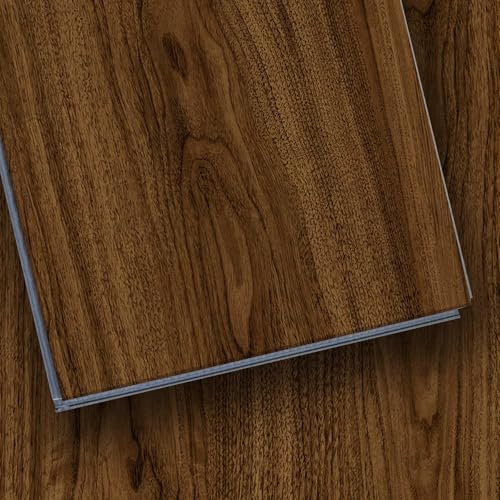
Basement survivors are rigid-core products, and SPC is the reason. Its limestone-filled core barely moves when slab vapour pushes, where hollow-core vinyl cups and clicks apart. Over a plastic vapour barrier, this floats above the moisted slab and holds joints tight through a decade of seasons.
Cold feels real underfoot, and a decent foam underlayment solves most of it while adding the vapour layer the system needs. Per box it is the costliest route here, and in basements the extra spec is exactly what the money buys.
2. Art3d 36-Pack Peel and Stick Vinyl Floor Tiles, Brown Stone — Best Featured-Area Tile
 Check On The Amazon.com
Disclosure: As an Amazon Associate, I earn from qualifying purchases.
| Format | Peel-and-stick tiles |
| Coverage | 54 sq ft |
| Look | Stone/brown wood |
| Install | Self-adhesive |
| Waterproof | Surface |
| Best for | Finished feature zones |
✅ Reasons to buy
- No glue mess,no tools beyond a knife and a metre
- Stone-look pattern hides slab imperfections panels would telegraph
- Modular repairs: swap one damaged tile rather than a room
❌ Reasons to avoid
- Adhesive bonds to the slab, so a damp slab defeats it
- Not for whole basements at this coverage per box
Where the slab is dry, peel-and-stick tiles give a finished look for a fraction of plank pricing. The stone-look pattern visually forgives the imperfect concrete that real basements have. One damaged tile swaps out in minutes, which whole-roll products cannot match.
The honest limit is adhesive: it bonds to the slab, and vapour under a bonded tile lifts it. Pass the plastic-sheet test first, or choose floating products instead. For a dry slab and a feature area, this is the cheap-and-convincing route.
3. VallisCo Peel and Stick Vinyl Flooring, Wood Look, 36 Pack — Best Full-Room Wood Look
 Check On The Amazon.com
Disclosure: As an Amazon Associate, I earn from qualifying purchases.
| Format | Peel-and-stick planks |
| Coverage | 54 sq ft |
| Look | Textured brown wood |
| Install | Self-adhesive |
| Pattern | Random-length planks |
| Best for | Family-room basements |
✅ Reasons to buy
- Textured grain reads as real plank at a stick-on price
- Random lengths lay like real timber and hide seams
- Scratch-resistant surface stands up to basement foot traffic
❌ Reasons to avoid
- Same adhesive honesty as every stick-down product
- Subfloor cleaning decides bond quality more than anything
This is the convincing wood-look version of stick-down flooring: textured grain, random plank lengths, and a scratch layer that treats basement traffic as normal use. In a dry-slab family room, the finished result is difficult to distinguish from click-lock at half the material budget.
Scrub the slab, vacuum it, and wipe before laying, because adhesive bonds to dust as readily as concrete. All stick-down products fail through prep laziness more than product quality, and this one is no exception.
4. Oxdigi Vinyl Flooring Roll, 53 sq ft — Best Roll Goods
 Check On The Amazon.com
Disclosure: As an Amazon Associate, I earn from qualifying purchases.
| Format | Single-sheet roll |
| Coverage | 53 sq ft |
| Width | 3 ft 4 in |
| Install | Tape or loose-lay |
| Waterproof | Full sheet |
| Best for | Fast whole-room coverage |
✅ Reasons to buy
- One sheet means no seams across most room widths
- Loose-lay option leaves the slab untouched for future recovery
- Waterproof edge to edge, no joint for vapour to exploit
❌ Reasons to avoid
- Roll width demands seams beyond eleven feet
- Dents under point loads, as any flexible sheet eventually shows
Roll goods solve the seam problem from the other direction. One continuous sheet has no joints for moisture to find, and it loose-lays over a dry slab without a single adhesive bead. For a fast, reversible basement floor, nothing else finishes a room in an afternoon the same way.
Beyond eleven feet of room width, joins appear, and they want the maker’s tape and patience. Point loads dent any flexible sheet eventually, which is the honest cost of the format. As a renter-friendly, reversible covering, the format is unmatched.
5. Livelynine Reclaimed Wood Vinyl Flooring Roll — Best Small-Budget Patch
 Check On The Amazon.com
Disclosure: As an Amazon Associate, I earn from qualifying purchases.
| Format | narrow roll |
| Size | 15.8 in x 78.8 in |
| Install | Peel-and-stick |
| Waterproof | Surface |
| Uses | Accent zones, repairs |
| Best for | Tiny budgets and patches |
✅ Reasons to buy
- The lowest-cost route to a finished-looking basement corner
- Ideal for patching, runners, and small feature strips
- Forgiving to cut around posts, sumps and cleanouts
❌ Reasons to avoid
- Accent-scale product, not a room solution
- Thin wear surface wants gentle treatment
Not every basement project is a room: sometimes it is a laundry corner, a step landing, or a patch where the old covering died. This narrow roll exists for exactly those jobs, at a price that removes the deliberation entirely. Cut it around sump lids and posts without grief.
Its wear surface is thin, which is fine for the light-duty zones it suits. For whole rooms, step up the list; for the stubborn corner no other product justifies, this is the piece that finishes the floor.
How We Chose
Coverings were chosen by how each handles slab vapour, then by installation reality: what a basement weekend actually allows. Floating rigid core, adhesive tile, and roll goods each answer the moisture question differently. That is why all three formats appear rather than five versions of one answer.
Solid hardwood and laminate were excluded on principle: both fail below grade in documented ways that no installation trick reverses. Every pick states its moisture ceiling honestly. Products claiming basement suitability without explaining vapour were treated as marketing, not evidence.
The Plastic-Sheet Test Comes First
Tape a two-foot square of plastic to the slab, seal the edges, and wait a full day. Droplets underneath mean vapour is moving, and every adhesive product on this page just left the running. A dry check means the whole list is open, including the cheap routes.
The test costs an afternoon and answers the question showrooms gloss over. Repeat it in the dampest corner, because slabs vary room to room. For floors with a history of visible damp, no covering fixes the slab; address drainage first.
Floating Beats Glued Below Grade
A floating floor sits on a vapour barrier and can be lifted when the slab misbehaves, which is a courtesy glued products cannot extend. Rigid-core click-lock floats, so it survives seasonal movement that cracks bonded installations. Below grade, the ability to un-lay a floor is a feature on par with the look.
Glued and stick-down products bond vapour pressure directly into their own failure. On a verified-dry slab they perform well for years, and the plastic-sheet test is what verifies dry. Skipping that step turns any adhesive choice into a future peel in progress.
Underlayment Is Where Comfort Comes From
Concrete is cold and unkind, and the floor covering above it inherits both traits. A foam underlayment under floating planks adds warmth underfoot, deadens sound, and works as the vapour layer, all in one roll. Peel-and-stick and roll goods sit thinner, and their rooms feel it.
Rugs recover the cold-zone problem in stick-down rooms without much cost. The combination of thin covering plus rugs suits rec rooms, while a proper underlayment suits daily-living basements. Your feet will grade this decision daily.
What Never Goes Below Grade
Solid hardwood and standard laminate both fail basements in the same way: their cores drink slab vapour, and the result is cupping and swelling no repair reverses. Bamboo behaves likewise. Engineered wood can work with rigid cores and sealed installations, though vinyl remains the honest default.
Carpet succeeds only with a vapour-barrier underlayment and a dehumidifier running nearby, and it remains the first thing a damp basement ruinously saturates. Every product family here is synthetic on purpose. Whatever the listing implies, below grade rewards waterproof choices. Rigid-core owners can also compare species notes in our engineered wood review.
Frequently Asked Questions
What is the most moisture-proof basement flooring?
Rigid-core vinyl (SPC) over a vapour-barrier underlayment. The core barely moves with slab humidity, and the floating install keeps the barrier continuous. Sheet vinyl is equally waterproof but thinner underfoot.
Can I put vinyl plank directly on concrete?
Yes, with a vapour-barrier underlayment beneath floating planks, or on a slab that passes the plastic-sheet test for stick-down versions. Skipping the barrier is the most common vinyl-in-basement failure.
Is peel and stick tile good for basements?
On a dry slab, yes, and it is the cheapest finished look available. On a slab with any vapour movement, adhesive tiles lift within months. The plastic-sheet test makes the decision unemotional.
How do I stop my basement floor from being cold?
A foam underlayment beneath floating plank, plus rugs in the sitting zones. The underlayment is the major factor, and it is also doing the vapour work. Expect the floor to feel dramatically different within a day of installation.
Do I need a subfloor in a basement?
Not for vinyl products, which float happily over barrier and slab. Raised subfloor panels remain useful for carpet or engineered wood, and for basements with a known damp history that wants separation from the slab.
Why did my basement floor covering peel up?
Slab vapour pushed the adhesive, or the slab was dusty or sealed when it was laid. Both are bond failures, not product defects. A vapour test and a scrubbed slab prevent the repeat.
📐 Free Tool: Flooring Calculator
Enter your room size — see exactly how many boxes you need, waste included.
Conclusion
Let the slab vote before the catalogue does, starting with the plastic-sheet test. Then choose floating rigid core for living space, stick-down tile for dry feature zones, or roll goods for the fastest reversible fix. Every pick on this page states its moisture ceiling in plain words.
Warmth comes from underlayment and rugs, not from the covering itself, and below grade that underlayment is doing double duty as the vapour barrier. Skip solid hardwood, question carpet, and the basement floor stops being an annual worry. For a deeper dive on rigid-core floating installs, our underlayment guide pairs with this page.


