
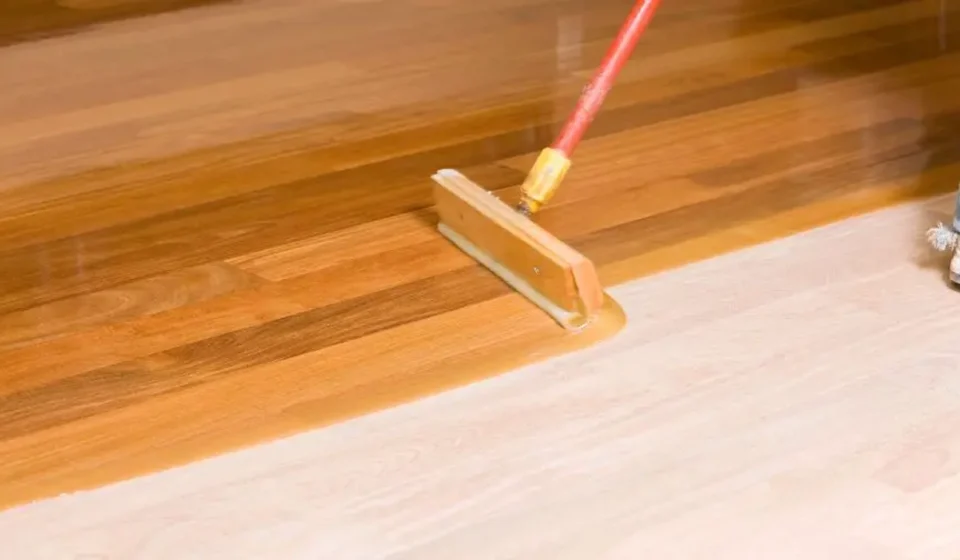

A freshly sanded hardwood floor can be ruined by one careless pass. Bubbles from a foam pad, shed bristles frozen in the cure, and lap marks from a dry edge all destroy a finish. One careless pass can undo a whole weekend of sanding. The finish is only as flat as the applicator that laid it, so choosing the right one matters as much as the polyurethane itself.
Natural lambswool is the clear winner for polyurethane work. Its dense fibers load finish evenly and release it in a self-leveling sheet, popping bubbles before the film sets. Foam pads trap air and shed, rollers leave texture, and brushes are too slow for whole floors. Wool applicators on blocks or T-bar frames are the floor-finish standard for a reason.
We ranked eight verified tools — lambswool blocks, T-bars, refill bundles, and one touch-up pen — each tested against lay-flat behavior, fiber retention, and whole-project economics. The right finish also starts with the right formula, so read our best polyurethane for floors guide before you buy a coat of anything. Then pick your applicator below.
Quick Verdict
Best Overall: Tru-Lamb 10″ Lambswool Floor Applicators (3-Pack) — natural wool that lays flat with zero shedding. Three fresh blocks per pack means one per coat, which is exactly how professionals avoid lap marks.
Best Budget: Tru Lamb 18″ T-Bar Applicator Handle + Sleeve — full-floor width at the lowest entry cost. The 18-inch head halves your passes across open rooms, and the T-bar keeps your hands away from the wet edge.
Best Premium: Wooster 12″ Wool Floor Applicator — professional-grade dense wool that carries the heaviest load. It feeds more finish per tray cycle and lays down the glass-like coats that pros charge for.
Comparison Table
| Product | Key Specs | Price |
|---|---|---|
| Tru-Lamb 10″ Lambswool Floor Applicators (3-Pack) | Natural lambswool blocks, 10-inch width, 3-pack for one project | Check Price on Amazon |
| Tru Lamb 18″ T-Bar Applicator Handle + Sleeve | 18-inch lightweight T-bar frame with one lambswool sleeve | Check Price on Amazon |
| Duratool 18″ T-Bar Applicator Bundle | 18-inch lightweight T-bar bundle with matching sleeve | Check Price on Amazon |
| Glosaie 18″ T-Bar Applicator + Extra Refill Sleeve | 18-inch T-bar with one refill sleeve included for a fresh face per coat | Check Price on Amazon |
| Ferrochef 7″ Lambswool Stain Applicator (3-Pack with Handle) | 7-inch lambswool pads with handle, 3-pack for stains and narrow poly work | Check Price on Amazon |
| Varathane Clear Scratch & Repair Floor Finish Pen | Water-based clear floor finish pen with precision tip for spot repair | Check Price on Amazon |
| Wooster 12″ Wool Floor Applicator | 12-inch professional-grade dense wool floor applicator block | Check Price on Amazon |
| Rust-Oleum 10″ Oil-Finish Applicator | 10-inch dense applicator pad tuned for oil-based floor finishes | Check Price on Amazon |
The Picks
1. Tru-Lamb 10″ Lambswool Floor Applicators (3-Pack) — Best Overall
 Check On The Amazon.com
Disclosure: As an Amazon Associate, I earn from qualifying purchases.
| Width | 10 inches |
| Fiber | 100% natural lambswool |
| Pack | 3 applicator blocks |
| Works with | Oil-based and water-based polyurethane |
| Best for | Flawless, bubble-free coats |
This is the finish default for good reason. The genuine lambswool face loads polyurethane deep into its fibers and releases it in an even, self-leveling sheet that settles flat as you drag. Bubbles pop on their own before flash-off, and the dense natural fiber refuses to shed into the wet coat.
The 3-pack sizing matches real project math: one fresh block per coat across a three-coat schedule. That keeps cured skin and grit out of the next layer, which is where most mysterious lap marks come from. Cleanup needs to happen immediately after each coat, since wool loads hold finish tenaciously.
✅ Reasons to buy
- Natural lambswool lays polyurethane flat and self-levels as you drag
- Dense fiber resists shedding into the wet coat
- Three-pack covers a full room with a fresh block per coat
- Works with both oil-based and water-based formulas
❌ Reasons to avoid
- Requires solvent or water cleanup immediately after every coat
- Hand block covers open plains more slowly than an 18-inch T-bar
2. Tru Lamb 18″ T-Bar Applicator Handle + Sleeve — Best Budget
 Check On The Amazon.com
Disclosure: As an Amazon Associate, I earn from qualifying purchases.
| Width | 18 inches |
| Frame | Lightweight T-bar handle |
| Sleeve | One lambswool sleeve included |
| Best for | Big rooms on a budget |
The cheapest route into wool-sleeve finishing. The 18-inch head covers open floor roughly twice as fast as a 10-inch block. The T-bar handle keeps your hands out of the tray and away from the wet edge you are feathering. The frame is genuinely light, which matters by the third coat of a big room.
The tradeoff is the single sleeve in the box. Reusing one sleeve across coats is exactly how grit and cured skin end up in your finish, so budget for refills before you start. You will also need a tray at least 18 inches wide, which is a separate purchase most first-timers forget.
✅ Reasons to buy
- 18-inch width halves the passes across open floors
- Lightweight T-bar keeps hands away from the wet edge
- Lowest entry cost into lambswool-sleeve finishing
❌ Reasons to avoid
- Only one sleeve in the box — order refills before starting
- Needs an 18-inch-wide tray, sold separately
3. Duratool 18″ T-Bar Applicator Bundle — Best for Edge Work
 Check On The Amazon.com
Disclosure: As an Amazon Associate, I earn from qualifying purchases.
| Width | 18 inches |
| Frame | Lightweight T-bar |
| Bundle | Handle plus one matching sleeve |
| Best for | Edge control near walls and trim |
Wide heads are awkward near baseboards, but the Duratool frame is light enough to steer with one hand. It tracks close to walls and around cabinet bases without tipping and digging a corner into the wet film, which is where most edge streaks come from. The bundle pricing keeps the refill math simple for multi-coat schedules.
The sleeve pile runs thinner than premium wool, so it loads less finish per pass and can starve the coat if you rush. Duratool hardware handles solvent cleanup well, though, and survives season after season if you rinse promptly. It is a control tool first, a speed tool second.
✅ Reasons to buy
- Light frame steers close to walls and cabinets without tipping
- Bundle pricing simplifies refill planning for multi-coat projects
- Hardware stands up to solvent cleanup across seasons
❌ Reasons to avoid
- Sleeve pile is thinner than premium wool, so loads less finish per pass
- No second sleeve included for fresh-per-coat discipline
4. Glosaie 18″ T-Bar Applicator + Extra Refill Sleeve — Best Upgrade
 Check On The Amazon.com
Disclosure: As an Amazon Associate, I earn from qualifying purchases.
| Width | 18 inches |
| Frame | T-bar handle |
| Sleeves | One fitted sleeve plus one refill |
| Best for | Full projects with fresh-per-coat discipline |
The Glosaie exists for one discipline: a fresh wool face per coat. The spare sleeve in the box makes that automatic instead of aspirational, so you never face the temptation to reuse a skinned-over sleeve for coat two. That single habit prevents more lap marks than any technique upgrade, which makes this the smartest mid-range buy.
The 18-inch width delivers whole-floor speed in the same package. The refill pile is decent rather than premium wool, so a third coat would still benefit from one more sleeve. The 18-inch tray requirement applies here too. For two- and three-coat projects, though, the box has you covered.
✅ Reasons to buy
- Refill sleeve included for a fresh wool face on the second and third coats
- Fresh-per-coat discipline is the biggest lap-mark preventer
- 18-inch width speeds whole-floor passes
❌ Reasons to avoid
- Refill pile quality is decent but below premium wool
- Still needs a separate 18-inch tray
5. Ferrochef 7″ Lambswool Stain Applicator (3-Pack with Handle) — Best Nook Kit
 Check On The Amazon.com
Disclosure: As an Amazon Associate, I earn from qualifying purchases.
| Width | 7 inches |
| Pack | 3 pads with one handle |
| Fiber | Lambswool |
| Works with | Stains and polyurethane |
| Best for | Stairs, risers, and closets |
Every project has the places 18-inch heads cannot turn: stair treads, risers, pantry floors, and the strips behind radiators. The 7-inch Ferrochef pads go there. The lambswool pile holds poly evenly even on vertical risers, where thin pads drip and streak, and the included handle gives real reach into tight corners.
Three pads keep the fresh-per-coat rule alive across a staircase project, which is where most people cheat with one reused pad. The handle grip is basic, and the narrow width makes this slow on open plains. Pair it with a T-bar for the main field and use this where precision matters.
✅ Reasons to buy
- 7-inch width fits stair treads, risers, and closets where wide heads cannot turn
- Lambswool pile holds poly evenly on vertical risers without dripping
- Three pads keep fresh-per-coat discipline on staircase projects
❌ Reasons to avoid
- Too slow for open floor plans on its own
- Handle grip is basic, not ergonomic for long sessions
6. Varathane Clear Scratch & Repair Floor Finish Pen — Best for Touch-Ups
 Check On The Amazon.com
Disclosure: As an Amazon Associate, I earn from qualifying purchases.
| Type | Finish pen, not a coat applicator |
| Color | Clear |
| Chemistry | Water-based |
| Scope | Spot repair |
| Best for | Scratch triage between recoats |
Strictly speaking this is not an applicator — it is a repair tool, and it earned its slot anyway. The precision tip fills hairline scratches with clear finish so you do not have to recoat an entire board for one nick. The water-based chemistry blends into existing modern finish layers without the ambering you get from oil-based dab jobs.
It is the honest companion to a full applicator kit, not a replacement for one. Deep gouges still need sanding, and the sheen match is good but not perfect against high-gloss coats. Keep it in the drawer and use it the day a chair leg wins.
✅ Reasons to buy
- Precision tip fills hairline scratches without recoating the whole board
- Water-based chemistry blends into existing modern finish layers
- The honest between-coats companion for floors that take daily abuse
❌ Reasons to avoid
- Not an applicator — deep gouges still need sanding first
- Sheen match is good, not perfect, on high-gloss coats
7. Wooster 12″ Wool Floor Applicator — Best Premium Pick
 Check On The Amazon.com
Disclosure: As an Amazon Associate, I earn from qualifying purchases.
| Width | 12 inches |
| Fiber | Professional-grade dense wool |
| Class | Professional |
| Best for | Pro-grade laydown and heavy loads |
This is what finishing contractors reach for when the coat has to be glass. The dense professional wool carries more finish per load than anything else here. Fewer tray cycles means fewer drips and a steadier wet edge across long passes. The laydown quality is visibly a class up: zero-streak coats that level like poured glass.
The premium shows up in durability too, since the Wooster tooling survives repeated cleanups across seasons instead of shedding out after one project. The 12-inch face splits the difference between speed and control — not the fastest plain-closer, not the nimblest edge tool. Buy it once, finish for years.
✅ Reasons to buy
- Dense professional wool holds more finish per load — fewer tray cycles, fewer drips
- Zero-streak glass coats, the laydown finishers charge for
- Tooling survives repeated cleanups across seasons
❌ Reasons to avoid
- Premium price of the bracket
- 12-inch width splits the difference — not the fastest for open plains
8. Rust-Oleum 10″ Oil-Finish Applicator — Best for Sealing Coats
 Check On The Amazon.com
Disclosure: As an Amazon Associate, I earn from qualifying purchases.
| Width | 10 inches |
| Face | Dense pad |
| Tuned for | Oil-based polyurethane and penetrating oils |
| Best for | Sealing coats before topcoats |
A specialist pad for oil-based systems. The dense face is tuned for oil chemistry, so it lays sealing coats without the bubbling that generic pads trigger in oil formulas. The light block glides easily across that first penetrating coat, which is the coat that sets the tone for everything above it.
Plan one pad per coat, since only a single pad comes in the box. It is also less forgiving on water-based topcoats than wool, so keep it dedicated to the oil lane. If your project starts oil-based, this is the easy button for coat one.
✅ Reasons to buy
- Pad face tuned for oil-based polyurethane and penetrating oils — no bubbling
- Light block glides on sealing coats before topcoats
- Chemistry matched to Rust-Oleum’s own floor finish systems
❌ Reasons to avoid
- Single pad in the box — plan one per coat
- Less forgiving on water-based topcoats than wool
Lambswool vs. Foam vs. Pads: Why Wool Wins for Polyurethane
The applicator choice is really a physics question. Lambswool loads finish into millions of fine fibers and releases it in an even film. The film self-levels as you drag, and bubbles pop themselves before the film flashes off.
Foam pads do the opposite: they trap air during loading and dump it into the coat as micro-bubbles that freeze in the cure. Synthetic pads split the difference but tend to shed more than wool.
That is why every top pick on this list is wool. For oil-based polyurethane, foam rollers are a known failure mode: they aerate a formula that needs long, slow leveling. The result is a permanent orange-peel texture across the room. Microfiber rollers have a legitimate place with water-based formulas, but for the classic polyurethane-on-hardwood job, natural wool remains the physics-correct choice.
Water-Based vs. Oil-Based: Handling Each Correctly
Your polyurethane chemistry changes how you handle the tool. Water-based poly cures fast, so the working window is measured in minutes. Rinse the applicator in water immediately after each coat, apply quickly, and resist the urge to re-brush — second passes drag the film. Oil-based poly cures slowly with long recoat windows, which gives forgiving self-leveling but a bigger dust-skin risk between coats.
Wool applicators handle both chemistries well, which is why they dominate this list. The Rust-Oleum pad is deliberately tuned for oil. For water-based work, a T-bar or synthetic roller is the standard, since it lays thin coats without introducing excess air.
If you have not chosen your formula yet, our best water-based polyurethane for floors guide compares the top options side by side. Either way, match the tool to the chemistry and follow the can’s recoat timing.
Preventing Cloudy or Milky Finishes
A cloudy or milky cast in a cured coat almost always traces back to conditions, not the applicator. Applying water-based poly in cold or humid air traps moisture as the film dries, and that trapped moisture scatters light into a hazy finish.
The fix is environmental: work between roughly 60 and 77 degrees Fahrenheit with relative humidity under 70 percent. Keep a gentle cross-breeze going, but never point a fan directly at the wet surface.
Recoating too soon is the other classic cause. If the previous coat has not stopped grabbing, the new coat locks solvent or moisture underneath and the film clouds from within. Wait the full recoat window on the can, then sand lightly before the next coat. Dust nibs and a milky film are often cured into the same impatient afternoon.
Tools themselves rarely cloud a finish, but wool releases thinner, more even films than foam. Those films dry more predictably in marginal conditions.
Frequently Asked Questions
What is the best applicator for polyurethane on hardwood floors?
Natural lambswool is the best applicator for polyurethane on hardwood floors. Use a 10-inch lambswool block like the Tru-Lamb 3-pack for control near edges, or an 18-inch T-bar for speed across open plains.
Lambswool or foam applicator for polyurethane?
Lambswool wins decisively. It releases finish without trapping air, so coats come out bubble-free and self-leveled. Foam pads aerate oil-based formulas and inject micro-bubbles that freeze into the cure, leaving a permanent orange-peel texture.
Can I use a paint roller for polyurethane on hardwood floors?
It is not recommended for oil-based polyurethane, since rollers aerate the finish and leave orange-peel texture. A microfiber roller can work for water-based poly, but lambswool applicators and T-bars remain the floor-finish standard for both chemistries.
How do I avoid lap marks when applying polyurethane?
Maintain a wet edge and work with the grain, always dragging toward wet finish instead of reversing into a curing edge. The other two rules: use a fresh sleeve or block per coat. Reused applicators carry cured skin and grit into the next layer. Keep the room ventilated so edges do not flash before you reach them.
Do I need to sand between coats of polyurethane?
Yes, sand lightly between every coat. Use 220-grit sandpaper or a screening pad to knock down dust nibs and give the next coat adhesion. Then vacuum and tack-cloth the dust away before recoating. Skipping this is why coats peel and feel rough underfoot. When the project is done, keep tools serviceable — our guide to cleaning polyurethane from a brush covers the rinse discipline that keeps applicators reusable.
Conclusion
The best polyurethane applicator is wool matched to the job. The Tru-Lamb 3-pack gives flawless control, the 18-inch T-bars give whole-floor speed, the Wooster gives pro-grade loads, and the Ferrochef kit covers stairs and closets. Eight tools, one principle — natural wool lays finish flat. Use fresh faces per coat, keep a wet edge every pass, and the finish takes care of itself.
Keep that discipline through the cure, then protect the finished floor the way you protected the finish. Place furniture pads for hardwood floors under every chair leg before a single one touches the new coat. The cure takes a week or more, so treat the floor gently and enjoy the glass-smooth result.


