


Hardwood and rolling chairs are a bad pairing. Every pushback digs four hard castors into the finish, and over months that pressure leaves dents, dull trails and scratches no polish fully hides. A chair mat breaks that contact. It only works if it is the right kind. It needs smooth backing for bare wood, enough thickness to spread the load, and an edge the castors roll over without catching.
We compared five mats on exactly those points: backing type, thickness, and the real roll zone each one covers. If your chair spends most of its life on bare wood, add chair wheels made for hardwood floors alongside any of these mats. Softer wheels treat the finish more gently than stock plastic castors, cutting the daily abrasion further.
What follows is the shortlist of five mats. Then comes the buying detail. You will learn how to read backing labels and how thick a mat needs to be. You will also see how to size it to your chair’s travel, plus the maintenance step that turns protection into scratches when skipped.
Quick Verdict
Best Overall: Kuyal Clear Chair Mat, 36 x 48 in — smooth backing that marks nothing, beveled edge, and clear PVC that keeps the floor visible.
Best Budget: Office Chair Mat for Hard Floors, 36 x 48 in — a full-size mat with anti-slip texture for the smallest outlay on this list.
Best Premium: Baroyal Office Chair Mat, Anti-Slip PVC — heavier-gauge PVC that resists castor dents longer, aimed at heavy daily users.
Best Value: SHAREWIN Office Chair Mat, 36 x 47 in — beveled edge and flat-laying PVC sized for a standard desk footprint.
Best for Small Spaces: Riveroy Office Chair Mat, Large — big coverage in a budget-friendly mat that tucks under compact desks.
Quick Comparison Table
| Product | Award | Key Spec | Price |
|---|---|---|---|
| Kuyal Clear Chair Mat, 36 x 48 in | Best Overall | Clear PVC, smooth backing, beveled edge | Check Price on Amazon |
| Office Chair Mat for Hard Floors, 36 x 48 in | Best Budget | Anti-slip waterproof mat for hard floors | Check Price on Amazon |
| SHAREWIN Office Chair Mat, 36 x 47 in | Best Value | Beveled edge, smooth back, 36 x 47 in | Check Price on Amazon |
| Baroyal Office Chair Mat, Anti-Slip PVC | Best Premium | Heavy-gauge PVC, anti-slip backing | Check Price on Amazon |
| Riveroy Office Chair Mat, Large | Best for Small Spaces | Large non-slip mat for hard floors | Check Price on Amazon |
The Picks
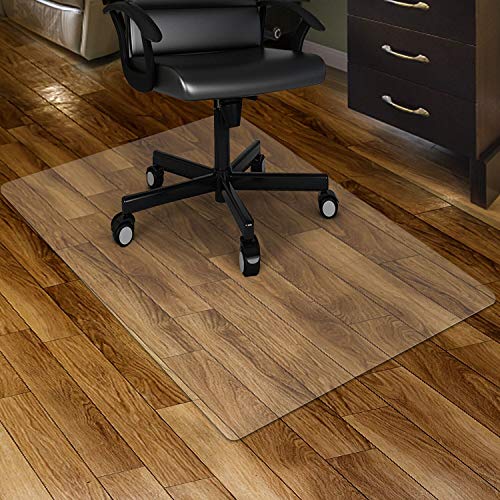
1. Kuyal Clear Chair Mat, 36 x 48 in — Best Overall
 Check On The Amazon.com
Disclosure: As an Amazon Associate, I earn from qualifying purchases.
| Size | 36 x 48 in |
| Material | Clear PVC |
| Backing | Smooth, for hard floors |
| Edge | Beveled |
| Best for | Home office on hardwood |
Thirty-six by forty-eight inches covers the standard roll zone of a desk chair — roughly your feet plus the chair base. The smooth backing is what makes it right for hardwood: no cleats to press marks into the finish, nothing to grip and gouge. The clear PVC keeps the floor visible, so a good-looking wood floor stays the visual focus of the room.
This is the default pick for a standard home-office desk chair. It suits anyone who wants the mat to disappear into the room. Skip it if your desk sits in strong direct sun all day, since clear PVC yellows over years. It also creeps on ultra-glossy finishes, where a grippier mat holds better.
✅ Reasons to buy
- Smooth underside leaves no marks on hardwood finishes
- Beveled edge lets castors roll on without catching
- Clear finish keeps the wood grain fully visible
❌ Reasons to avoid
- Clear PVC can yellow in direct sunlight over several years
- Smooth back can slide on very glossy floor finishes
2. Office Chair Mat for Hard Floors, 36 x 48 in — Best Budget
 Check On The Amazon.com
Disclosure: As an Amazon Associate, I earn from qualifying purchases.
| Size | 36 x 48 in |
| Material | PVC |
| Backing | Textured anti-slip |
| Surface | Waterproof |
| Best for | Budget home offices |
This is the cheapest route to a full 36 by 48 roll zone on the list. The textured underside grips laminate, vinyl, and hardwood, so the mat stays put where a smooth-backed mat would creep. The waterproof surface wipes clean, which makes it forgiving in a home office where coffee spills happen.
It fits light chairs and occasional use well — a spare-desk setup or a student room, for example. Heavy daily users should buy thickness instead. Thin PVC dents under sustained point load, the dent never recovers, and a cheap mat replaced yearly costs more in the end.
✅ Reasons to buy
- Full-size coverage at the lowest outlay on this list
- Anti-slip texture holds position on slick floors
- Waterproof surface wipes clean of spills
❌ Reasons to avoid
- Thinner than the premium picks, so it dents sooner
- Textured top can feel grippy under bare feet
3. SHAREWIN Office Chair Mat, 36 x 47 in — Best Value
 Check On The Amazon.com
Disclosure: As an Amazon Associate, I earn from qualifying purchases.
| Size | 36 x 47 in |
| Material | PVC |
| Backing | Smooth, for hard floors |
| Edge | Beveled |
| Best for | Daily desk use |
The beveled edge is the detail that matters here daily. A square-cut mat catches the castors every time you roll on, and that little lip takes abuse until it cracks. SHAREWIN’s sloped edge lets the chair glide on cleanly, and the mat lies flat from day one without the corner curl that plagues rolled cheap mats.
This is the balanced pick for a chair that rolls a few hours a day in a home office. It suits a standard desk footprint. Skip it if you need the full 48-inch depth. It runs one inch shorter than the other 36-inch mats here, and direct sun yellows the PVC over time.
✅ Reasons to buy
- Beveled edge means no lip for castors to catch on
- Sits flat without curling at the corners
- Sized to match a standard desk footprint
❌ Reasons to avoid
- One inch shallower than the 48-inch mats on this list
- PVC will yellow over years in direct sunlight
4. Baroyal Office Chair Mat, Anti-Slip PVC — Best Premium
 Check On The Amazon.com
Disclosure: As an Amazon Associate, I earn from qualifying purchases.
| Size | 36 x 48 in |
| Material | Heavy-gauge PVC |
| Backing | Anti-slip |
| Edge | Beveled |
| Best for | Heavy daily use |
The extra thickness is the whole point of this mat. Castor dents come from point load over time. More material under the castors spreads that load. A heavy user on a thin mat gets permanent dents in months, while a thick mat keeps its surface. The anti-slip backing and beveled edge complete the package for floors that otherwise let mats creep.
This is the pick for someone who sits eight hours a day, or for a chair carrying a heavier user. It fits a full-time home office. Skip it if you rearrange often. The same thickness that resists dents makes the mat heavier to lift, and since trapped grit scratches floors, you will be lifting it to sweep regularly.
✅ Reasons to buy
- Thicker PVC spreads castor load and resists dents longer
- Anti-slip backing holds on smooth hardwood
- Beveled edge for smooth roll-on
❌ Reasons to avoid
- Heavier to lift when cleaning underneath
- Costs more than the standard mats here
5. Riveroy Office Chair Mat, Large — Best for Small Spaces
 Check On The Amazon.com
Disclosure: As an Amazon Associate, I earn from qualifying purchases.
| Size | Large format |
| Material | PVC |
| Backing | Non-slip |
| Edge | Standard |
| Best for | Compact desks |
This large-format mat costs the least of any here, which makes it the practical choice for a compact desk. A full 36 by 48 mat would overhang the chair line in that setting. The non-slip backing keeps it from wandering during a workday, which matters more in a tight space because a creeping mat ends up under the chair legs.
This fits a small desk in a bedroom corner or apartment setup. It suits a chair that moves less. The standard square edge catches castors each time you roll on, and the thinner PVC dents sooner under a heavy user than the Baroyal above.
✅ Reasons to buy
- Large coverage for the least money on this list
- Non-slip backing keeps it in position
- Fits under a compact desk without overhang
❌ Reasons to avoid
- Standard edge catches castors on roll-on
- Thinner PVC dents sooner under heavy daily use
Do Hardwood Floors Really Need a Chair Mat?
Yes, if the chair rolls on the bare wood. A seated adult spreads roughly sixty kilos across four tiny castor points, and that concentrated pressure is exactly what dents hardwood. Add daily rolling, and the castors also drag grit across the finish, leaving dull trails that are really thousands of micro-scratches.
There are two alternatives. Soft polyurethane chair wheels spread and soften rolling contact, and some people skip mats entirely with them. The other route is a rug over the chair zone, but a rug needs a pad made for the floor. Pair it with one of the rug pads built for hardwood floors, not bare rug backing. Bare backing can scuff a finish as badly as no mat.
A mat is still the cheapest and most predictable protection of the three. It costs less than refinishing one room, it installs in seconds, and it removes the guesswork about whether your wheels are gentle enough. For anyone renting, it is also the only option that leaves zero trace.
PVC, Polycarbonate, or Glass: Picking the Material
Most mats on this list are PVC, and it is the practical default: flexible, affordable, and smooth enough not to mark a finish. Its weakness is time. Thin PVC dents under sustained point load, and clear PVC yellows after years in direct sun. Both are slow processes, but they are why a ten-dollar mat can end up costing a floor.
Polycarbonate is the step up that ranking guides keep naming for hardwood. It is stiffer than PVC, so it resists denting and lies flatter. It also does not develop the tiny underside dimples that trap grit against the floor. It costs more, but it is the material most often recommended for heavy chairs and long hours.
Tempered glass sits above both. It cannot dent at all, it never yellows, and chairs glide across it almost silently. The trade-offs are real: it costs far more, it can crack if you drop something heavy on an edge, and it needs anti-slip pads to stay put. Glass suits a permanent desk setup where the mat will never move; everyone else gets better value from thick plastic.
Sizing the Mat to the Chair’s Roll Zone
A mat has to be larger than the chair’s travel. Sit in the chair and push back as far as you naturally do. Then measure from the desk edge to the rearmost castor and add several inches of margin. Castors rolling off a too-small mat are what gouge a floor at the edge line, which is exactly the damage the mat was bought to prevent.
The standard 36 by 48 inch size fits most desk chairs because it covers the feet plus the full chair base. Taller people who push back far should go wider. So should chairs with a wide five-star base — 45 by 53 and 46 by 60 sizes exist for that. An oversized mat can be trimmed with a knife or tucked under furniture; an undersized one can only be replaced.
Also think about the edge profile where the chair rolls on. Beveled edges let castors glide over without catching, which matters every time you sit down. Square-cut edges catch and flex, and that flexing is where cracks start on thinner mats.
Keeping Grit From Scratching the Finish
A mat that traps grit is worse than a bare floor, because it holds the abrasive in constant contact with the finish. The underside of a mat is the one place a floor never gets cleaned otherwise, so it becomes the dirtiest spot in the room over months. Polishing scratches into the finish there is invisible until you move the mat and find a dull rectangle.
Lift the mat and sweep underneath monthly. Shake the mat out at the same time, and avoid mats with deep textures that hold debris. When you mop the exposed floor around it, reach for one of the cleaners formulated for hardwood floors instead of an all-purpose spray. Leftover residue films give grit more to cling to.
Frequently Asked Questions
Do chair mats damage hardwood floors?
Only the wrong kind. Smooth-backed mats protect hardwood; studded or cleated mats press marks into the finish. Keep the underside clean too — trapped grit under any mat will polish scratches into the wood over months.
What thickness should a chair mat be on hardwood?
Around 2 to 3 mm is the practical minimum for a light chair. Anyone sitting several hours a day should go thicker. Thickness is what spreads the castor point load and prevents the dents that thin mats develop.
Can I use a carpet chair mat on hardwood?
No. Carpet mats carry cleats meant to grip pile, and those cleats press marks into a wood finish. Buy a mat labeled for hard floors with a smooth or anti-slip backing, never one with studs.
Are glass chair mats worth it for hardwood?
They are the best material technically — no dents, no yellowing, near-silent rolling. But they cost several times more than PVC, can crack under a dropped heavy object, and need anti-slip pads to stay put. For a warmer look at a lower cost, consider the rugs picked to sit under desks on hardwood. They cover the roll zone without any plastic at all.
Why does my chair mat keep sliding?
Smooth back plus smooth floor equals no grip. Switch to a mat with an anti-slip or textured backing. You can also add small adhesive grip dots under a smooth mat, or choose a heavier-gauge mat that stays put by weight. The Kuyal’s smooth back is great for the finish but will creep on very glossy floors.
Conclusion
A chair mat protects a hardwood floor only when the backing matches the floor: smooth or anti-slip for wood, never cleated. Thickness is the second decision. Light chairs get by on standard mats. Heavy daily users should buy the thickest mat they can justify, since thin PVC dents under sustained load and the dent never recovers.
Of the five here, the Kuyal is the default for a standard home office. The budget mat covers a spare desk for the least money. SHAREWIN is the balanced daily-driver, the Baroyal is the heavy-user upgrade, and the Riveroy fits a compact desk. Whichever you choose, lift it and sweep underneath monthly — grit trapped under a mat is what turns protection into scratches.


