


A best robo vacuum cleaner is really an autonomy purchase: the value comes from how little you have to do between runs, not from how well it cleans for ten minutes. Dock capacity, map stability, and brush design determine whether the robot works unattended or turns into a daily rescue mission.
We researched eight top-rated robo vacuums, from a long-interval roborock and a pass-focused Shark to budget self-emptying models with multi-floor maps, verifying every suction, dock, and runtime figure against its listing. There are no lab tests and no prices here, only the practical differences that decide how much of the work actually leaves your hands.
Quick Verdict
Best Overall: roborock Q7 M5+ Robot Vacuum and Mop (White) — 10,000Pa suction, a seven-to-nine-week self-empty dock, and dependable mapping
Best Pass Quality: Shark AV2501S AI Ultra — Matrix Clean overlapping passes and a sealed HEPA base
Best Entry Autonomy: VONKO Robot Vacuum and Mop — a 60-day self-empty base and multi-level maps at the entry position
Quick Comparison Table
| Product | Best For | Key Spec / Feature | Check Price |
|---|---|---|---|
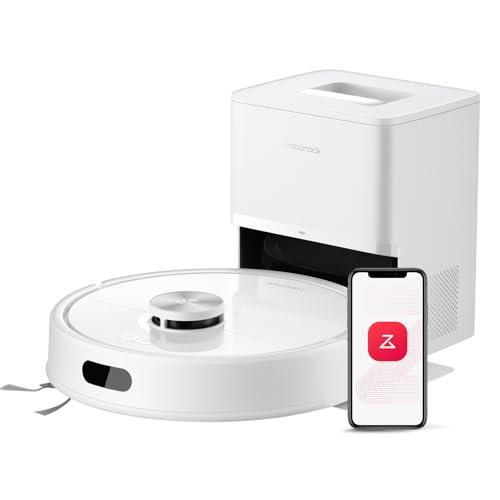 roborock Q7 M5+ Robot Vacuum and Mop (White) | Weeks between interventions | 10,000Pa, 7-9 week self-empty, dual anti-tangle | Check Price on Amazon |
 Shark AV2501S AI Ultra Robot Vacuum | Thorough overlapping passes | Matrix Clean, 30-day HEPA bagless base | Check Price on Amazon |
 Tikom L8000 Plus Robot Vacuum and Mop | Long dock interval for less | 90-day self-empty capacity, 6000Pa, LiDAR | Check Price on Amazon |
 ILIFE A30s Plus Robot Vacuum | Long runtime on open floors | 150-minute runtime, 10,000Pa, self-empty station | Check Price on Amazon |
 VONKO Robot Vacuum and Mop | Self-emptying on a small budget | 8000Pa, 60-day self-empty, multi-level maps | Check Price on Amazon |
 LVKANGDA Robot Vacuum and Mop Combo | Strongest pull for carpet | 12,000Pa, dToF laser navigation, 90-day dock | Check Price on Amazon |
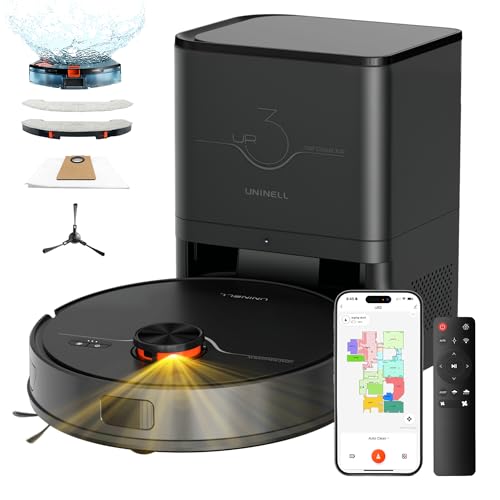 Uninell Robot Vacuum and Mop | Zones and multi-floor maps | 7000Pa, LiDAR self-empty, custom no-go zones | Check Price on Amazon |
 Shark AV2501AE AI Robot Vacuum | Two months of debris, sealed | XL HEPA self-empty base, 60-day capacity | Check Price on Amazon |
Schedules and Dock Cycles — What This List Actually Checked
This list is for buyers who want the robot to handle the routine unattended, rather than requiring a daily check-in.
- Dock cycle: how many days or weeks pass before the bin needs attention
- Map stability: whether saved rooms and no-go zones survive furniture being moved
- Brush design: anti-tangle or comb rollers that stop hair binding the axle
- Runtime and resume behaviour, because a robot that quits mid-floor is not autonomous
Read the comparison table and each pick’s Best for and Skip if line, then open full reviews only for the robots whose dock interval fits your home.
These are researched picks from current listings rather than lab-tested claims, and every dock capacity, suction, and navigation detail was verified on the product page.
1. roborock Q7 M5+ Robot Vacuum and Mop (White) — Best Overall Autonomy
Best for: Households that want weeks between interventions on hard floors and low-pile carpet. | Skip if: Your home is deep pile carpet throughout.
Check On The Amazon.comDisclosure: As an Amazon Associate, I earn from qualifying purchases.
| Spec | Detail |
|---|---|
| Suction | 10,000Pa claimed |
| Dock | Self-empty, 7-9 weeks |
| Brush | Dual anti-tangle system |
| Navigation | PreciSense LiDAR |
Reasons to Buy
- Seven to nine weeks between bin changes in normal use
- Dual anti-tangle system prevents brush binding
- LiDAR mapping keeps coverage repeatable
Reasons to Avoid
- Dock needs a permanent wall position
- Mop is for maintenance rather than dried spills
Autonomy is measured by how rarely you intervene, and a seven-to-nine-week dock interval is the strongest answer here. Pair that with an anti-tangle brush and the robot stops needing the two interventions that usually break the habit.
2. Shark AV2501S AI Ultra Robot Vacuum — Best Pass Quality
Best for: Mixed-floor homes where one thorough pass matters more than a long dock interval. | Skip if: You want the longest possible gap between emptying trips.
Check On The Amazon.comDisclosure: As an Amazon Associate, I earn from qualifying purchases.
| Spec | Detail |
|---|---|
| Cleaning | Matrix Clean overlapping pattern |
| Dock | 30-day HEPA bagless base |
| Navigation | Home mapping |
| Control | Wi-Fi app |
Reasons to Buy
- Overlapping passes lift more dirt than a single line
- HEPA base seals dust during emptying
- Mapping keeps routes consistent between runs
Reasons to Avoid
- Thirty-day capacity trails longer docks
- No mop function
Robots are light, so pass quality compensates for what they lack in weight, and overlapping passes are the mechanism. With a sealed HEPA base and stable mapping, this is the choice when cleaning depth matters more than a two-month bin interval.
3. Tikom L8000 Plus Robot Vacuum and Mop — Best Dock Interval Value
Best for: Busy homes that want the longest possible interval without paying the top tier. | Skip if: Carpet is the dominant surface and you need maximum suction.
Check On The Amazon.comDisclosure: As an Amazon Associate, I earn from qualifying purchases.
| Spec | Detail |
|---|---|
| Dock | Self-empty, up to 90 days |
| Suction | 6000Pa claimed |
| Navigation | LiDAR mapping |
| Function | Vacuum and mop |
Reasons to Buy
- Ninety-day base capacity is the longest here
- LiDAR mapping gives usable room-by-room coverage
- Mop function handles kitchen crumbs between deep cleans
Reasons to Avoid
- 6000Pa is modest for deep carpet
- Mop pad requires manual rinsing
If autonomy means touching the machine as rarely as possible, a ninety-day dock is the specification that delivers it. It gives up suction on carpet, which matters less in a home that is mostly hard floor and low-pile rugs.
4. ILIFE A30s Plus Robot Vacuum — Best Runtime for Large Floors
Best for: Open-plan homes where a short battery would leave half the floor untouched. | Skip if: Your home is compact and 150 minutes is unnecessary.
Check On The Amazon.comDisclosure: As an Amazon Associate, I earn from qualifying purchases.
| Spec | Detail |
|---|---|
| Runtime | Up to 150 minutes |
| Suction | 10,000Pa claimed |
| Dock | Self-emptying station |
| Navigation | LiDAR mapping |
Reasons to Buy
- 150 minutes covers a large floor in one charge
- 10,000Pa ceiling keeps power competitive
- Self-empty station removes daily bin duty
Reasons to Avoid
- Long runtime means slower passes at maximum power
- Station filter needs periodic cleaning
A robot that runs out of charge halfway across an open plan is not autonomous, whatever its suction figure says. Endurance is the specification that makes the rest of the features usable, and 150 minutes is the most generous here.
5. VONKO Robot Vacuum and Mop — Best Entry Autonomy
Best for: First-time buyers who want self-emptying and multi-level maps on a small budget. | Skip if: You need proven long-term app support.
Check On The Amazon.comDisclosure: As an Amazon Associate, I earn from qualifying purchases.
| Spec | Detail |
|---|---|
| Suction | 8000Pa claimed |
| Dock | Self-empty, 60 days |
| Navigation | LiDAR, multi-level maps |
| Control | App and voice |
Reasons to Buy
- Sixty-day base capacity at the entry position
- Multi-level maps cover two floors with one robot
- 8000Pa suction is competitive in the band
Reasons to Avoid
- Newer brand with a shorter support record
- App is simpler than the major brands
The entry price still includes a sixty-day dock and multi-level mapping, which is unusual in this band. It is the sensible way to test whether a robo vacuum changes your routine before spending flagship money on the idea.
6. LVKANGDA Robot Vacuum and Mop Combo — Best Suction for Carpet
Best for: Carpet-heavy rooms that need the strongest pull in this comparison. | Skip if: You prefer an established brand ecosystem.
Check On The Amazon.comDisclosure: As an Amazon Associate, I earn from qualifying purchases.
| Spec | Detail |
|---|---|
| Suction | 12,000Pa claimed |
| Navigation | dToF laser, 5 maps |
| Dock | Self-empty, up to 90 days |
| Brush | Anti-tangle |
Reasons to Buy
- 12,000Pa is the highest rating here
- dToF laser maps reliably in low light
- Ninety-day dock capacity reduces emptying to a rarity
Reasons to Avoid
- Maximum suction shortens runtime noticeably
- Support network is thinner than the majors
When carpet is the main surface, suction decides whether grit leaves the pile, and this is the strongest claim in the group. It also pairs that with a ninety-day dock, so the power does not come at the cost of autonomy.
7. Uninell Robot Vacuum and Mop — Best Zones and Multi-Floor Mapping
Best for: Two-storey homes and open kitchens that need restriction zones around cables and pet bowls. | Skip if: You live on one level and never need restrictions.
Check On The Amazon.comDisclosure: As an Amazon Associate, I earn from qualifying purchases.
| Spec | Detail |
|---|---|
| Suction | 7000Pa claimed |
| Dock | Self-empty station |
| Navigation | LiDAR, multi-floor |
| Zones | Custom no-go zones |
Reasons to Buy
- No-go zones keep the robot out of cables and pet bowls
- Multi-floor maps remove the need to carry it upstairs
- Quieter operation suits open living areas
Reasons to Avoid
- 7000Pa sits below the strongest carpet picks
- Quiet mode trades speed for noise
Autonomy fails most often when a robot tangles itself, and no-go zones are the practical fix. Add multi-floor mapping and the machine covers a staircase home without being carried, which is what makes it genuinely unattended.
8. Shark AV2501AE AI Robot Vacuum — Best Debris Containment
Best for: Pet homes that want two months of debris held in a sealed HEPA container. | Skip if: You want mopping built in.
Check On The Amazon.comDisclosure: As an Amazon Associate, I earn from qualifying purchases.
| Spec | Detail |
|---|---|
| Dock | XL HEPA self-empty base |
| Capacity | Up to 60 days |
| Navigation | LiDAR home mapping |
| Control | Wi-Fi, Alexa |
Reasons to Buy
- HEPA base contains dander instead of venting it
- Sixty-day capacity cuts debris handling
- Bagless base avoids buying bags
Reasons to Avoid
- No mop function
- Large base footprint
Containment is the autonomy feature people forget, because emptying a dusty bin is the task that erodes the habit. A sealed HEPA base holding two months of debris removes both the frequency and the unpleasantness of that job.
Quick Decision
The picks below are based only on product features — every bullet comes from that pick’s own spec table or its own Reasons to Buy.
Best all-round: roborock Q7 M5+ Robot Vacuum and Mop (White)
- Weeks between bin changes
- Anti-tangle brush system
- Repeatable LiDAR coverage
Best pass quality: Shark AV2501S AI Ultra Robot Vacuum
- Overlapping cleaning passes
- Sealed HEPA base
- Consistent mapped routes
Best entry autonomy: VONKO Robot Vacuum and Mop
- Sixty-day self-empty base
- Multi-level maps
- Suction competitive for the band
How a Robo Vacuum Spends Its Battery
Suction Mode Decides the Clock
A robot allocates battery between movement, navigation, and suction, and maximum suction dominates that budget. That is why a 150-minute rating usually refers to a quiet mode, and why high-power runs end far sooner than the label suggests.
Return-to-Dock Behaviour Matters More
A robot that recharges and resumes is more useful than one with a longer single-charge runtime, because large floors get finished either way. Check whether the model resumes automatically, since this determines whether a flat or a house is realistic.
Mapping Reduces Wasted Movement
A mapped route avoids re-cleaning the same strip, which effectively extends battery life. Over time, stable mapping does more for coverage than a marginal increase in rated minutes on the box.
What was left out and why: cordless sticks and manual vacuums were excluded because this list is about robo vacuums, and models without a stated dock capacity or navigation type were dropped rather than estimated. Runtime and suction figures are manufacturer-rated and were not independently measured.
FAQ: Robo Vacuum Schedules and Dock Care
How often should a robo vacuum run?
Daily on hard floors is ideal, because light passes stop grit being walked in. With a long dock interval you can schedule daily runs and only think about the machine once a month.
Do I need to empty it between runs?
With a 60 to 90-day base, no, but you should check the filter every few weeks and rinse the mop pad if the model has one. Shorter 30-day docks need emptying roughly monthly.
Will a robo vacuum get stuck?
It can, which is why no-go zones and cable management matter more than extra sensors. Clearing floors of loose cables before a run prevents most incidents.
Can a robo vacuum handle pet hair?
Daily surface hair, yes, especially with an anti-tangle brush. Embedded hair in thick carpet still needs a full-size vacuum occasionally.
Should I choose LiDAR or camera navigation?
LiDAR maps consistently in low light, while cameras can recognise objects but struggle in the dark. For reliable coverage, laser navigation is the safer choice.
🔍 Free Tool: Vacuum Finder Quiz
Answer 6 quick questions — get your top 3 vacuum matches.
Conclusion
For the most hands-off experience the roborock Q7 M5+ White leads, with the Shark AV2501S close behind when cleaning depth matters more than dock interval. Choose the VONKO if you want to test autonomy on a small budget.
Next, decide how often you are willing to touch the machine, then compare the dock capacity line on the two robots that fit that answer. If you are still weighing a robo vacuum against a manual machine, the vacuum finder tool below narrows it by floor type and home size.


