


An economical robot vacuum cleaner is not the cheapest one on the page, it is the one whose running costs stay low after the first year. Docks that hold weeks of debris, washable filters, and brushes that resist hair wrap matter more than the purchase figure.
We researched five top-rated robots that stay sensible over time, from a VONKO with a sixty-day base to a roborock with a long dock interval and anti-tangle brushes, verifying every capacity and filter detail against its listing. There are no lab tests and no prices here, only the practical differences that decide which economical robot remains cheap to own.
Quick Verdict
Best Overall Value: VONKO Robot Vacuum and Mop — a sixty-day self-empty base and multi-level maps at the entry position
Best Dock Interval: Tikom L8000 Plus — a ninety-day dock capacity that removes the most frequent chore
Best Long-Term Buy: roborock Q7 M5+ — anti-tangle brushes and a seven-to-nine-week dock that keep performance stable
Quick Comparison Table
| Product | Best For | Key Spec / Feature | Check Price |
|---|---|---|---|
 VONKO Robot Vacuum and Mop | Self-emptying and mapping for less | 8000Pa, 60-day self-empty, multi-level maps | Check Price on Amazon |
 Tikom L8000 Plus Robot Vacuum and Mop | Longest emptying interval for the outlay | 90-day self-empty capacity, 6000Pa, LiDAR | Check Price on Amazon |
 ILIFE A30s Plus Robot Vacuum | One robot covers a large floor | 150-minute runtime, 10,000Pa, self-empty station | Check Price on Amazon |
 roborock Q7 M5+ Robot Vacuum and Mop | Pay once, keep it working | 10,000Pa, 7-9 week self-empty, dual anti-tangle | Check Price on Amazon |
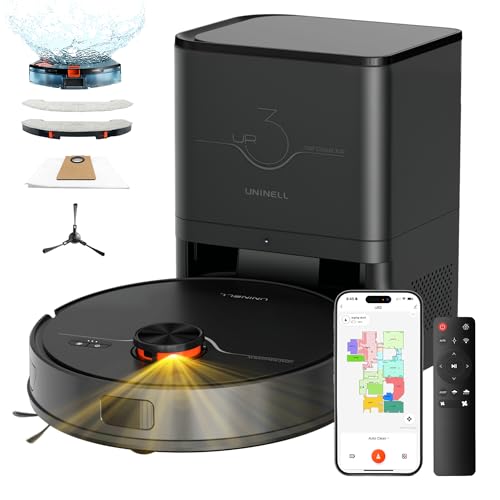 Uninell Robot Vacuum and Mop | Zones prevent rescues and repairs | 7000Pa, LiDAR self-empty, custom no-go zones | Check Price on Amazon |
Running Costs and Consumables — What This List Actually Checked
This list is for buyers who want the lowest cost of ownership rather than the lowest sticker figure.
- Dock capacity in days or weeks, because frequent emptying is a labour cost you pay repeatedly
- Filter and brush availability, since proprietary consumables are where cheap robots become expensive
- Brush design, because hair wrap shortens roller life and reduces pickup
- Mapping quality, since a robot that cleans efficiently uses less battery and fewer passes
Read the comparison table and each pick’s Best for and Skip if line, then open full reviews only for the robots whose consumables you can source.
These are researched picks from current listings rather than lab-tested claims, and every capacity and filter detail was verified on the product page.
1. VONKO Robot Vacuum and Mop — Best Overall Economy
Best for: First-time buyers who want self-emptying and mapping without a premium outlay. | Skip if: You need a long track record of app support.
Check On The Amazon.comDisclosure: As an Amazon Associate, I earn from qualifying purchases.
| Spec | Detail |
|---|---|
| Suction | 8000Pa claimed |
| Dock | Self-empty, 60 days |
| Navigation | LiDAR, multi-level maps |
| Function | Vacuum and mop |
Reasons to Buy
- Sixty-day base capacity keeps emptying infrequent
- Multi-level maps cover two floors with one robot
- 8000Pa suction is competitive for the band
Reasons to Avoid
- Newer brand with a shorter support record
- App is simpler than the major platforms
Economical here means a sixty-day dock and real mapping at an entry position, because both reduce the labour a robot is supposed to remove. It is the sensible first purchase for someone who wants the routine handled without overpaying for flagship features.
2. Tikom L8000 Plus Robot Vacuum and Mop — Best Dock Interval for the Money
Best for: Busy homes that want the longest gap between emptying trips per pound spent. | Skip if: Carpet is dominant and you need maximum suction.
Check On The Amazon.comDisclosure: As an Amazon Associate, I earn from qualifying purchases.
| Spec | Detail |
|---|---|
| Dock | Self-empty, up to 90 days |
| Suction | 6000Pa claimed |
| Navigation | LiDAR mapping |
| Function | Vacuum and mop |
Reasons to Buy
- Ninety-day dock capacity is the longest here
- LiDAR mapping reduces wasted passes
- Mop function covers everyday floor film
Reasons to Avoid
- 6000Pa is modest on thick carpet
- Mop pad requires hand rinsing
The economics of a robot are dominated by how often you touch it, and ninety days between empties is the strongest answer in this group. On hard floors the modest suction costs little, while the interval is felt every single week.
3. ILIFE A30s Plus Robot Vacuum — Best Runtime for the Money
Best for: Open-plan homes where a short runtime would mean buying a second robot. | Skip if: Your home is compact and 150 minutes is unnecessary.
Check On The Amazon.comDisclosure: As an Amazon Associate, I earn from qualifying purchases.
| Spec | Detail |
|---|---|
| Runtime | Up to 150 minutes |
| Suction | 10,000Pa claimed |
| Dock | Self-emptying station |
| Navigation | LiDAR mapping |
Reasons to Buy
- 150 minutes avoids buying a second machine for a big floor
- 10,000Pa ceiling stays competitive
- Self-empty station reduces daily handling
Reasons to Avoid
- Slower passes at maximum suction
- Station filter needs periodic rinsing
Runtime is an economic specification when a short battery forces you to buy a second unit or to run the robot twice. At 150 minutes with a 10,000Pa ceiling, one machine covers a large floor and keeps the cost of ownership down.
4. roborock Q7 M5+ Robot Vacuum and Mop — Best Long-Term Value
Best for: Buyers who would rather pay once and keep the machine working for years. | Skip if: Your budget is fixed at the entry level and cannot stretch.
Check On The Amazon.comDisclosure: As an Amazon Associate, I earn from qualifying purchases.
| Spec | Detail |
|---|---|
| Suction | 10,000Pa claimed |
| Dock | Self-empty, 7-9 weeks |
| Brush | Dual anti-tangle system |
| Navigation | PreciSense LiDAR |
Reasons to Buy
- Anti-tangle brushes extend the working life of the roller
- Seven to nine weeks between bin changes
- Mapping quality reduces wasted cleaning passes
Reasons to Avoid
- Higher initial outlay than the entry picks
- Dock requires permanent floor space
Long-term economy comes from parts that do not wear out early, and dual anti-tangle brushes are the clearest example of that principle. With a long dock interval, the routine keeps running without replacement purchases piling up.
5. Uninell Robot Vacuum and Mop — Best Zones for the Money
Best for: Homes with rugs and pet bowls where zones prevent avoidable repairs and rescues. | Skip if: You have one open floor with no obstacles.
Check On The Amazon.comDisclosure: As an Amazon Associate, I earn from qualifying purchases.
| Spec | Detail |
|---|---|
| Suction | 7000Pa claimed |
| Dock | Self-empty station |
| Navigation | LiDAR, multi-floor |
| Zones | Custom no-go zones |
Reasons to Buy
- No-go zones prevent tangles that cost time and parts
- Multi-floor maps cover both levels
- Quieter operation suits open living areas
Reasons to Avoid
- 7000Pa sits below the strongest picks
- Quiet mode trades speed for noise
Zones look like a convenience feature until a robot drags a rug fringe or wraps a cable, and then they are a repair bill avoided. For an economical purchase, preventing those incidents is one of the cheapest upgrades available.
Quick Decision
The picks below are based only on product features — every bullet comes from that pick’s own spec table or its own Reasons to Buy.
Best all-round value: VONKO Robot Vacuum and Mop
- Sixty-day dock capacity
- Multi-level maps
- Competitive suction for the band
Best interval: Tikom L8000 Plus Robot Vacuum and Mop
- Ninety-day capacity
- LiDAR mapping
- Mop for daily film
Best long-term: roborock Q7 M5+ Robot Vacuum and Mop
- Anti-tangle brushes
- Weeks between bin changes
- Efficient mapped routes
Where Budget Robots Cut Corners
Mapping Is the Usual Saving
The cheapest robots often use gyroscope navigation rather than LiDAR, which produces wandering routes and missed strips. That inefficiency shows up as longer runtimes and more battery cycles, both of which shorten the machine’s useful life.
Brushes and Filters Are the Second Saving
Thin rollers wear faster and cheap filters clog sooner, and both are ordered repeatedly. Checking that replacements are widely stocked and inexpensive matters more than the initial figure.
Dock Capacity Is a Labour Cost
A thirty-day dock means twelve emptying events a year, while ninety days means four. Multiply that by the years you keep the robot and the difference is the real economy of the purchase.
What was left out and why: no model was selected on price alone, and robots without a stated dock capacity or navigation type were excluded rather than estimated. Long-term battery degradation and repair rates are not independently verified here.
FAQ: Economical Robot Vacuum Ownership
Is a cheap robot vacuum a false economy?
Often, if it lacks mapping and uses thin consumables. A mid-priced robot with LiDAR and stocked filters usually costs less over three years than two cheap replacements.
How much do filters and brushes cost over time?
That varies by model, so check listings before buying. A widely sold model with inexpensive third-party filters is the safest economical choice.
Does a self-empty dock save money?
It saves time rather than money directly, but it keeps the robot in use, which is what makes the purchase worthwhile. Docks ranging from 60 to 90 days are the sweet spot for value.
Should I buy a refurbished robot?
It can be sensible if the battery is new and the model is still supported. Check that consumables are available, since a discontinued robot becomes worthless when filters run out.
How long should an economical robot last?
Three to four years with filter cleaning and brush maintenance. Battery replacement is the usual first expense, so confirm the pack is available.
🔍 Free Tool: Vacuum Finder Quiz
Answer 6 quick questions — get your top 3 vacuum matches.
Conclusion
For the best overall economy the VONKO is the sensible entry, while the Tikom L8000 Plus wins on emptying interval and the roborock Q7 M5+ on long-term durability. All three keep running costs low rather than just the sticker figure.
Next, check that filters and brushes for the exact model are stocked and inexpensive, then compare dock capacity across your shortlist. If you are still choosing between a robot and a manual vacuum, the vacuum finder tool below narrows it by home size.


