


A squeaking floor is usually a fastening problem, not a flooring problem. The wrong screw either snaps under load, strips the joist, or leaves a head that refuses to sit flush under underlayment. Getting the screw right is the cheapest fix in the whole build.
We pulled seven fasteners from the live Amazon catalog and filtered on one question: is this sold for subfloor-to-joist work rather than general carpentry? Collated strips won slots because they suit the screw guns that make a subfloor job bearable.
Below you get the length rule and the head and drive choices that avoid cam-out. The corrosion question decides whether stainless is worth the money in your climate.
Quick Verdict
Best Overall: Simpson Strong-Tie WSV2S #9 x 2 in — purpose-built subfloor screw with nibbed head
Best for Thicker Panels: Simpson WSV212S #9 x 2-1/2 in — same geometry in a longer length
Best for Overlay Work: Simpson WSV134S #9 x 1-3/4 in — short body for underlayment and patch panels
Best Budget Collated: SENCO Duraspin #8 x 1-3/4 — proven strip format at a low entry
Best Bulk Value: GVAKMM #8 x 2 in 1000-count — square drive, coarse thread, storage bucket
Best Structural Alternative: Simpson Deck-Drive DSVT212S #10 x 2-1/2 — deck-grade body for sistered repairs
Quick Comparison Table
| Product | Award | Key Spec | Check Price |
|---|---|---|---|
| Simpson Strong-Tie WSV2S Subfloor Screw, #9 x 2 in, 2000-Qty | Best Overall | Collated, #9 x 2 in, 6-lobe T-25, rimmed flat head with nibs, yellow-zinc | Check Price on Amazon |
| Simpson Strong-Tie WSV212S Subfloor Screw, #9 x 2-1/2 in, 1500-Qty | Best for Thicker Panels | Collated, #9 x 2-1/2 in, 6-lobe T-25, rimmed flat head with nibs, yellow-zinc | Check Price on Amazon |
| Simpson Strong-Tie WSV134S Subfloor Screw, #9 x 1-3/4 in, 2000-Qty | Best for Overlay Work | Collated, #9 x 1-3/4 in, 6-lobe T-25, rimmed flat head with nibs, yellow-zinc | Check Price on Amazon |
| SENCO Duraspin Collated Flooring Screw, #8 x 1-3/4, 1000ct | Best Budget Collated | Collated, #8 x 1-3/4 in, #2 square drive, flat head, zinc finish | Check Price on Amazon |
| GVAKMM #8 x 2 in Subfloor Collated Screws, 1000 Count | Best Bulk Value | Collated, #8 x 2 in, square drive, flat head, coarse thread, yellow zinc, bucket | Check Price on Amazon |
| Simpson Strong-Tie Deck-Drive DSVT212S, #10 x 2-1/2 in, 1000-Qty | Best Structural Alternative | Collated, #10 x 2-1/2 in, T-25, rimmed flat head, Quik Guard coating, low-torque thread | Check Price on Amazon |
| US4 #10 x 2-1/2 in Stainless Subfloor Screws, 350-Qty | Best for Damp Areas | 305 stainless steel, #10 x 2-1/2 in, T25 star drive, self-drilling | Check Price on Amazon |
The Picks
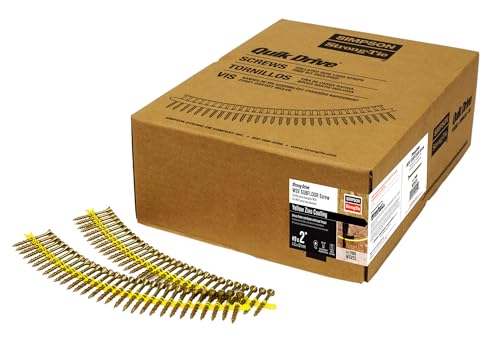
1. Simpson Strong-Tie WSV2S Subfloor Screw, #9 x 2 in, 2000-Qty — Best Overall
 Check On The Amazon.com
Disclosure: As an Amazon Associate, I earn from qualifying purchases.
| Type | Collated subfloor screw |
| Size | #9 x 2 in |
| Drive | 6-lobe T-25 |
| Head | Rimmed flat, with nibs |
| Coating | Yellow zinc |
| Quantity | 2,000 |
✅ Reasons to buy
- Head nibs countersink cleanly without a separate pre-drill
- Collated strips keep a screw gun moving at walking pace
- Two-inch length suits standard panel thickness over joists
❌ Reasons to avoid
- Yellow zinc is not the answer for treated lumber in wet areas
- Bulk box is heavy to move around a site
Simpson designed this screw for the exact job in the keyword: pulling panels down onto joists without a pilot hole. The nibs under the head ream the surface so the head finishes flush, which is what stops telegraphing through thin underlayment.
It is the default for a normal 3/4-inch panel over wood joists. Buy the 2-1/2 inch version instead if your panel is thicker or you are screwing through an existing layer.
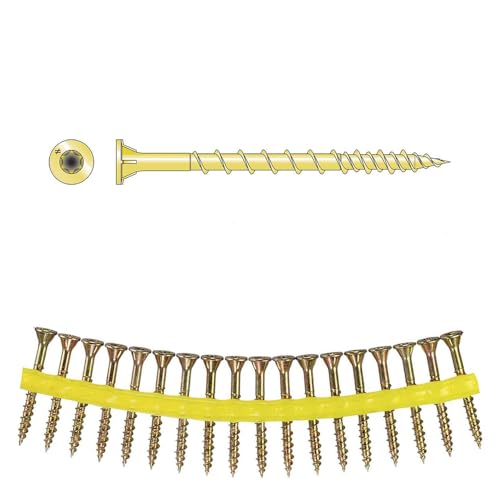
2. Simpson Strong-Tie WSV212S Subfloor Screw, #9 x 2-1/2 in, 1500-Qty — Best for Thicker Panels
 Check On The Amazon.com
Disclosure: As an Amazon Associate, I earn from qualifying purchases.
| Type | Collated subfloor screw |
| Size | #9 x 2-1/2 in |
| Drive | 6-lobe T-25 |
| Head | Rimmed flat, with nibs |
| Coating | Yellow zinc |
| Quantity | 1,500 |
✅ Reasons to buy
- Extra half inch buys real embedment into the joist
- Same nibbed head geometry as the two-inch version
- Handles thicker panels without bottoming out
❌ Reasons to avoid
- Too long for thin underlayment layers
- Fewer screws per box than the two-inch pack
Length is the one spec people get wrong most often. The rule of thumb is simple: penetrate the joist by at least an inch, and this 2-1/2 inch body does that through a standard panel.
Use it when your panel is thicker than nominal or you are fastening a second layer over an existing subfloor. For 3/4-inch panels, the two-inch version keeps more thread in solid wood.
3. Simpson Strong-Tie WSV134S Subfloor Screw, #9 x 1-3/4 in, 2000-Qty — Best for Overlay Work
 Check On The Amazon.com
Disclosure: As an Amazon Associate, I earn from qualifying purchases.
| Type | Collated subfloor screw |
| Size | #9 x 1-3/4 in |
| Drive | 6-lobe T-25 |
| Head | Rimmed flat, with nibs |
| Coating | Yellow zinc |
| Quantity | 2,000 |
✅ Reasons to buy
- Short body is right for underlayment and patch panels
- Nibbed head sits flush under vinyl and laminate
- Same strip format as the rest of the family
❌ Reasons to avoid
- Will not reach a joist through a full-thickness panel
- Easy to over-drive in soft plywood
This is the screw for the layer above the subfloor. It suits patch panels, thin underlayment, and repairs where you fasten panel to panel rather than panel to joist.
Keep it in the same box as the longer versions so nobody grabs the wrong strip mid-job. If your aim is structural, this is not the length.
4. SENCO Duraspin Collated Flooring Screw, #8 x 1-3/4, 1000ct — Best Budget Collated
 Check On The Amazon.com
Disclosure: As an Amazon Associate, I earn from qualifying purchases.
| Type | Collated flooring screw |
| Size | #8 x 1-3/4 in |
| Drive | #2 square |
| Head | Flat |
| Coating | Zinc |
| Quantity | 1,000 |
✅ Reasons to buy
- Square drive resists cam-out better than Phillips
- Proven strip format for common screw guns
- Low entry cost for a first subfloor repair
❌ Reasons to avoid
- Thinner #8 body suits lighter panels only
- Zinc finish is not for exterior or treated timber
SENCO has supplied collated fasteners to flooring crews for decades, and this strip is the budget route into that system. Square drive keeps the bit seated when you are working overhead or at an awkward angle.
It suits underlayment and light panel work. For a full subfloor replacement, the #9 Simpson bodies carry more load.
5. GVAKMM #8 x 2 in Subfloor Collated Screws, 1000 Count — Best Bulk Value
 Check On The Amazon.com
Disclosure: As an Amazon Associate, I earn from qualifying purchases.
| Type | Collated subfloor screw |
| Size | #8 x 2 in |
| Drive | Square |
| Head | Flat |
| Thread | Coarse |
| Quantity | 1,000 with bucket |
✅ Reasons to buy
- Coarse thread bites soft pine joists quickly
- Storage bucket survives site life better than a cardboard box
- Two-inch length covers standard panel thickness
❌ Reasons to avoid
- Square drive bits wear faster than star drives
- No nibbed head, so flush seating needs more care
This is the practical bulk buy for a one-room repair. Coarse threads pull fast in soft framing, and the bucket keeps strips dry and together between sessions.
The trade-off is head geometry: without nibs you must control depth with the clutch. Set it low, test on scrap, then commit.
6. Simpson Strong-Tie Deck-Drive DSVT212S, #10 x 2-1/2 in, 1000-Qty — Best Structural Alternative
 Check On The Amazon.com
Disclosure: As an Amazon Associate, I earn from qualifying purchases.
| Type | Collated structural screw |
| Size | #10 x 2-1/2 in |
| Drive | T-25 6-lobe |
| Head | Rimmed flat |
| Coating | Quik Guard |
| Quantity | 1,000 |
✅ Reasons to buy
- Thicker #10 body for sistered or repaired framing
- Low-torque thread reduces splitting near board ends
- Quik Guard coating suits damp crawl spaces
❌ Reasons to avoid
- Overkill for a simple panel-to-joist pass
- Costs more per screw than the #9 subfloor line
When a joist is soft, sistered, or repaired, a deck-grade body earns its cost. The low-torque thread profile is the important part: it resists splitting right where subfloor screws usually split.
Keep a box for repairs and problem spans. Routine field work stays faster and cheaper with the #9 subfloor screws above.
7. US4 #10 x 2-1/2 in Stainless Subfloor Screws, 350-Qty — Best for Damp Areas
 Check On The Amazon.com
Disclosure: As an Amazon Associate, I earn from qualifying purchases.
| Type | Stainless wood screw |
| Size | #10 x 2-1/2 in |
| Material | 305 stainless |
| Drive | T25 star |
| Point | Self-drilling |
| Quantity | 350 |
✅ Reasons to buy
- Stainless resists corrosion where zinc coatings fail
- Self-drilling point avoids pilot holes in most softwood
- Star drive holds up under repeated driving
❌ Reasons to avoid
- Stainless is softer and snaps if over-torqued
- Smaller pack at a higher per-screw cost
Bathrooms, laundry rooms, and anything over a damp crawl space change the fastener question from strength to corrosion. Stainless is the honest answer there, because a rusted screw loses grip before it loses length.
Use it selectively rather than everywhere. Stainless drives softer, so set the clutch low and let the screw pull itself home.
How We Chose
Every pick had to be sold for subfloor or flooring-to-wood work in its own listing, not just described as a general wood screw.
We then compared drive type, head geometry, and coating against the three failures that happen on site. Those are cam-out, heads that refuse to sit flush, and corrosion in damp assemblies.
The Length Rule That Prevents Squeaks
The working rule is simple: the screw must pass through the panel and bite at least an inch into the joist. For a nominal 3/4-inch panel that puts you in the two-inch to two-and-a-half-inch range.
Too short and the screw only holds the panel against itself. Too long and it can exit the joist or hit a wire. Measure your panel, then add the embedment you need.
Why Subfloor Screws Beat Nails
Nails hold by friction and work loose as framing dries and shrinks. Screws hold by thread engagement, which survives seasonal movement far better in a floor assembly.
The catch is heads. A screw head that sits proud telegraphs through vinyl and laminate within a season. That is why rimmed, nibbed heads appear on most picks above.
Head and Drive: Avoid Cam-Out
Star and square drives transmit torque without the bit climbing out of the head, which is why they dominate flooring work. Phillips remains common on general-purpose screws and remains the wrong choice here.
Cam-out strips the head, and a stripped screw in a subfloor is a genuine problem to remove. Buy a fresh bit for each box of screws; worn bits cause more damage than bad technique.
Coating and Corrosion by Room
Yellow zinc handles dry interior framing. It does not handle treated lumber, bathrooms, or crawl-space humidity, where the coating fails and the screw rusts from the shank outward.
Stainless costs more but solves the problem permanently. A middle route is a deck-grade coated screw in damp but not wet assemblies such as a vented crawl space.
Collated versus Loose Screws
Collated strips feed a screw gun automatically, which turns a two-person job into a one-person job at walking pace. On a full room, the time saving is measured in hours, not minutes.
Loose screws make sense for a patch repair. If you are doing more than a sheet, borrow or buy a collated gun and let the strips do the work.
Panel Thickness and Layering
Screwing through an existing layer changes everything. The screw must pass both layers and still reach the joist, so length climbs quickly and the risk of hitting a pipe rises with it.
Check what is under the floor before you choose a length. Our subfloor material guide covers panel types, and the underlayment guide covers the layer above.
Depth Control and Over-Driving
Over-driving is the most common error: the head sinks below the surface, crushes the panel face, and creates a low spot the finished floor will show. Set the clutch on scrap first.
In soft plywood, reduce clutch tension two steps below the setting that seats flush on fir. Consistent depth matters more than speed on the final pass.
Frequently Asked Questions
What size screws should I use for subflooring?
For a 3/4-inch panel over wood joists, use two-inch to two-and-a-half-inch subfloor screws. The target is full panel penetration plus at least one inch of thread into the joist.
Are deck screws okay for subflooring?
Yes for repairs and sistered framing. Purpose-made subfloor screws seat better because their nibbed heads countersink flush without crushing the panel face.
Can I use drywall screws for the subfloor?
No. Drywall screws are brittle and snap under shear loads. A floor assembly moves, and brittle screws fail instead of flexing.
How far apart should subfloor screws go?
Field screws typically run every 8 to 12 inches on joists, with closer spacing at panel edges. Always follow the panel maker’s fastening schedule for your span.
Why do my screw heads show through vinyl flooring?
The head sat proud of the panel, or the panel face crushed when the screw over-drove. A nibbed flat head plus a correctly set clutch prevents both.
Do I need stainless screws in a bathroom?
Yes, in most cases. Bathroom subfloors see repeated moisture, and zinc coatings fail there. Stainless costs more per screw but removes the risk of hidden corrosion.
Conclusion
The subfloor screw question comes down to three things. You need enough embedment to kill the squeak, a flat nibbed head to keep the surface true, and a coating that survives the room.
Start with the #9 Simpson body for standard panels, keep a short length for overlay work, and reserve stainless for the damp rooms. The floor above will stay quiet and flat.


