

Dogs and hardwood can coexist – millions of homes prove it every year. What actually happens in less lucky houses is predictable: claw marks in front of the sofa, urine darkening the boards by the back door, and a once-smooth finish gone dull along the hallway racetrack. The good news is that almost all of that damage is preventable, first by choosing the right boards and finishes if you are installing, and second by a handful of cheap habits if you are not. This guide covers both: the hardwood options that genuinely stand up to dogs in 2026, and how to make your existing floor last longer with a dog in the house.
What Dogs Actually Do to Hardwood Floors
Understanding the three damage types decides which “dog-proof” features matter – buying against the wrong one wastes money.
- Scratches – claw tips grind into the finish and, on softer species, into the wood itself. Damage depth depends on finish hardness and species hardness (Janka rating), in that order.
- Urine stains – unsealed seams and uncoated edges wick moisture; urea darkens wood permanently within hours if it sits. Engineered cores and sealed edges resist far better than unsealed solid strip joints.
- Impact dents – dog bowls sliding, dropped chew toys, zoomies into furniture. Hardness helps, but felt pads and rugs do more than any species choice.
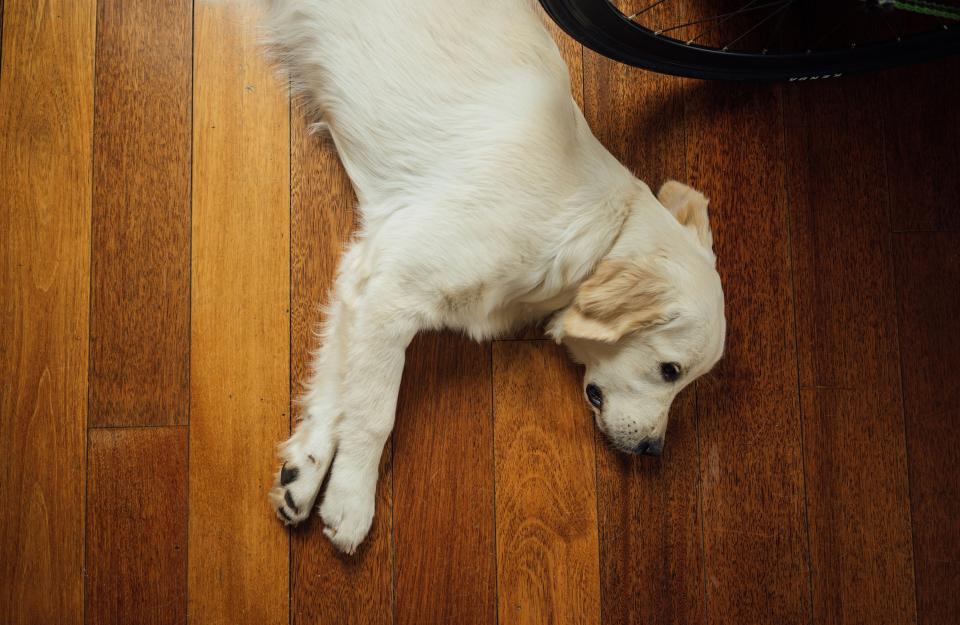
The Most Dog-Proof Hardwood Options (2026)
1. Hickory (Janka ~1820) – toughest common species
Hickory shoulders scratches and dents better than any widely stocked hardwood. Its dramatic color variation also hides minor wear – a practical, underrated feature for pet homes. It is harder to stain evenly than oak, so prefinished hickory with a factory wear layer is the smarter buy.
- ✅ Shoulders scratches and dents better than any widely stocked hardwood
- ✅ Dramatic color variation hides minor pet wear
- ✅ Widely stocked, so matching replacement boards later is realistic
- ❌ Harder to stain evenly than oak
- ❌ Site-finished boards expose that uneven-stain risk – prefinished with a factory wear layer is the smarter buy
2. White oak (Janka ~1360) – the balanced classic
White oak hits the sweet spot: genuinely hard, stable, and grandfathered into every design trend. Its closed grain takes sealers evenly, which matters because finish quality – not species – is the first line of defense against urine. Red oak works too, but its open grain absorbs moisture faster at exposed joints.
- ✅ Genuinely hard and dimensionally stable
- ✅ Closed grain takes sealers evenly – finish quality stays the first defense against urine
- ✅ Grandfathered into every design trend, so it will not date the room
- ❌ Softer than hickory (Janka ~1360 vs ~1820)
- ❌ The cheaper red-oak route absorbs moisture faster at exposed joints – a real risk in pet homes
3. Engineered hardwood with aluminum-oxide finish – best overall for dogs
A quality engineered board pairs a hard species veneer with cross-ply core stability (fewer gaps that swell when wet) and a factory-applied aluminum-oxide wear coat – effectively a ceramic-reinforced finish that resists claw abrasion several times longer than site-applied polyurethane. For most dog owners this is the rational first choice: harder surface, more stable core, and the finish does the scratch-fighting, not just the wood. Look for 3mm-plus wear layers so the floor can be refinished once or twice in its life.
- ✅ Hard-species veneer over a cross-ply core that gaps and swells less when wet
- ✅ Factory aluminum-oxide wear coat resists claw abrasion several times longer than site-applied polyurethane
- ✅ The finish does the scratch-fighting, not just the wood
- ✅ 3mm-plus wear layers allow a refinish once or twice in its life
- ❌ Aluminum-oxide cannot be spot-repaired – a deeply gouged board means replacement
- ❌ Thin wear layers give up that refinish option
4. Bamboo (strand-woven, Janka ~3000) – hardest, with caveats
Strand-woven bamboo out-hammers every wood on this list in hardness tests and shrugs off claws. The caveats: quality varies wildly between brands, cheaper products dent along the fibrous pattern and cannot be refinished well, and it performs badly in humid basements. Buy from a manufacturer that certifies formaldehyde standards and moisture ratings.
- ✅ Strand-woven hardness (Janka ~3000) out-hammers every wood on this list
- ✅ Shrugs off the claw traffic that scars softer species
- ❌ Quality varies wildly between brands
- ❌ Cheaper products dent along the fibrous pattern and cannot be refinished well
- ❌ Performs badly in humid basements
Quick Comparison: Dog-Proof Hardwood at a Glance
| Option | Hardness (Janka) | Standout trait for dogs | Watch out for |
|---|---|---|---|
| Strand-woven bamboo | ~3000 | Hardest surface, claw-proof feel | Quality spread, humidity limits |
| Hickory | ~1820 | Toughest true wood, hides scratches | Hard to stain on-site |
| Engineered white oak (AlOx) | ~1360 + finish | Stable core, strongest finish life | Wear layer must be 3mm+ |
| Solid white oak | ~1360 | Refinishable many times | Seasonal gaps wick moisture |
| American cherry / walnut | ~950 / 1010 | Beautiful, soft-feeling | Claws mark fast – avoid with dogs |
Products That Help Protect (and Repair) a Dog-Friendly Hardwood Floor
The floor choice does the heavy lifting, but these four tools cover the remaining failure points – finishing the boards you have, restoring shine that claws dulled, and cleaning up accidents before they stain.
1. Weiman Hardwood Floor Cleaner and Polish Restorer Bundle – the two-step maintenance pick: pH-neutral daily cleaner plus a polish-restorer that leaves a scratch-resistant sacrificial layer on traffic lanes. The clean-then-restore pairing matches exactly how finish wear actually happens. Check current price on Amazon
Disclosure: As an Amazon Associate, I earn from qualifying purchases.
2. Bona Hardwood Floor Polish (High Gloss) – one-bottle refresh for floors that look tired but are structurally fine; carnauba-based, dries in about an hour, and the cheapest way to reset a dull hallway before guests (or resale photos). Check current price on Amazon
3. Quick Shine Hardwood Floor Luster – the plant-derived, EPA Safer Choice option for homes where paws – and the occasional licked floor – make ingredient lists matter; non-slip when dry, no harsh residue. Check current price on Amazon
4. Bona PowerPlus Deep Cleaner (Refill) – for the enzymatic-adjacent deep clean after accidents and muddy-paw weeks; residue-free so it never leaves the sticky film that re-collects dog hair. Check current price on Amazon
The Finish Matters More Than the Species
A soft species under a hard finish outperforms a hard species under a soft one in daily claw contact. Three finish realities:
- Aluminum-oxide (factory-cured) – the toughest widely available option; embedded in the coating at the factory, lasts decades, but cannot be spot-repaired – board replacement is the fix.
- Polyurethane (site-applied) – good protection and repairable; reapply a maintenance coat every 3-5 years in dog homes and it keeps sealing the seams where urine would otherwise enter.
- Oil/wax finishes – look great, repair locally, but need the most upkeep in pet areas; spills must be wiped fast.
One more reason engineered boards lead this guide: their factory finish is machine-applied and UV-cured under ideal conditions – nearly impossible to duplicate with a brush in a furnished house.
Protecting an Existing Hardwood Floor from Your Dog
If new flooring is not in the budget this year, these habits do most of the heavy lifting:
- Trim nails every 2-3 weeks. Clicking claws on hard floors are audible proof that the finish is being sanded with every step. Short nails cut scratching dramatically – this single habit beats any product on this page.
- Felt pads under everything that moves. Chairs, bowls, crates, the toy bin. Replace them monthly – they collect grit and turn into sandpaper.
- Rugs on the racetrack. The hallway from couch to food bowl is where finish dies. Washable runner rugs with non-slip pads (no latex backing directly on the finish) absorb most of that traffic.
- Clean urine in minutes, not hours. Blot, then an enzymatic cleaner – never ammonia-based, which smells like urine chemistry to dogs and encourages repeat marking.
- Trim paw fur and keep bowls on mats. Water splashes around bowls seep between boards; a silicone mat contains the whole problem for a few dollars.
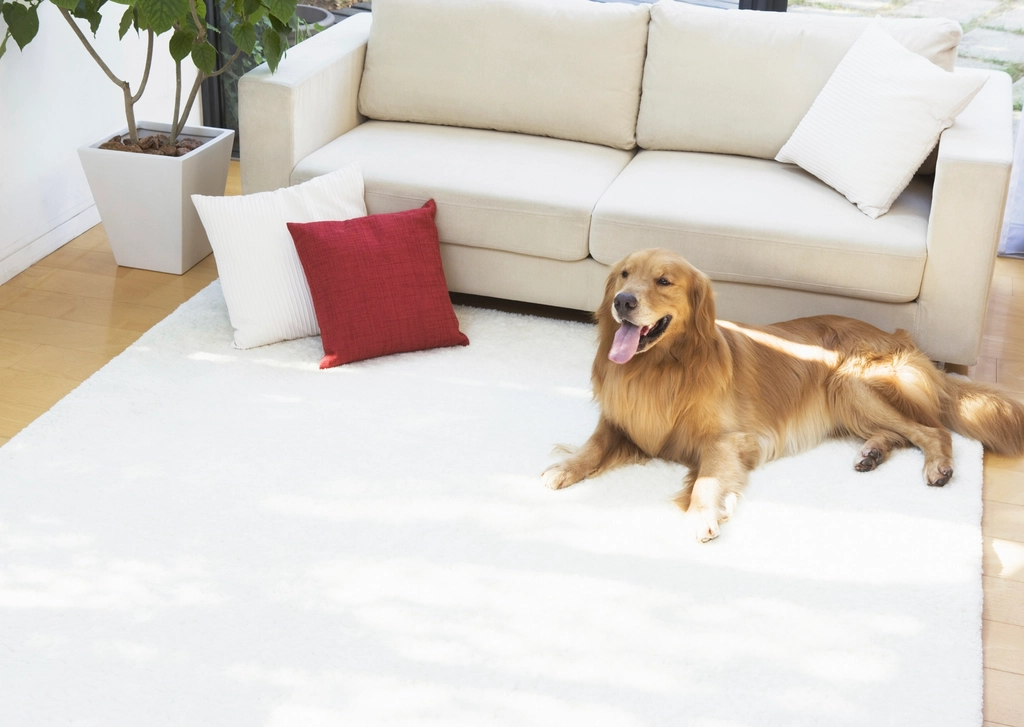
Fixing the Damage That Already Happened
Light surface scratches often disappear with a finishing-polish or wax product rated for your floor’s finish type; deeper gouges take a repair kit with filler sticks matched to the board color. Dark urine stains usually mean the finish was breached – light stains lift with wood bleach applied by a refinisher, but black-stained boards that have gone soft are a replacement job. If the whole floor is scratched cloudy, a screen-and-recoat (light abrasion plus a fresh polyurethane coat) restores the surface at a fraction of a full refinish – and re-flattens the protection your dog will immediately test again.
How We Chose
The options here compare species and constructions on the two axes that matter in dog homes: surface hardness against claws, and finish and core behavior against moisture and accidents. Janka ratings are manufacturer-published ball-park figures; wear-layer claims reflect factory-finish engineering, not lab testing. Sample boards in your own light, with your own dog, remain the final test.
Frequently Asked Questions
Will dog claws ruin hardwood floors?
Not if the finish stays intact. Claws abrade the coating first; the wood underneath only suffers once the finish is worn through. Hard species plus aluminum-oxide or well-maintained polyurethane finishes, with nails trimmed every few weeks, keep scratch damage cosmetic at worst.
What is the best hardwood floor for dogs that pee?
Engineered hardwood with a factory aluminum-oxide finish and an extended sealer over the joints. The cross-ply core swells less than solid wood when moisture sneaks past the seam, and the stronger finish delays that entry. Accidents still need blotting within minutes – no floor is truly urine-proof.
Is engineered hardwood better than solid hardwood for dog owners?
For most: yes. The factory finish is tougher than anything site-applied, the core is more dimensionally stable against pet-accident moisture, and quality boards with 3mm+ wear layers still refinish once or twice. Solid wood wins on lifespan and untrammeled refinishing, at the cost of more upkeep in pet households.
Are bamboo floors good for dogs?
Strand-woven bamboo is one of the hardest surfaces available and handles claws better than any wood species. Buy from a reputable brand – cheap bamboo dents oddly and refinishes poorly – and keep it out of damp basements.
How do I get dog urine smell out of hardwood?
Blot, then treat with an enzymatic cleaner designed for wood. If the smell persists, the urine reached raw wood through a finish gap; sealing the area after cleaning (or replacing the affected board) is the only full fix. Seal the odor, never just perfume it.
Do dog nails scratch polyurethane floors?
They dull and micro-scratch the top coat over time – visible as haze along traffic lanes. It is maintenance, not destruction: a screen-and-recoat every few years replaces the abraded coat, and trimmed nails slow the process to a crawl.
📐 Free Tool: Flooring Calculator
Enter your room size — see exactly how many boxes you need, waste included.
Conclusion
Dog-proof hardwood is a system, not a product: a hard species or stable engineered core, a factory-tough finish, and owner habits that keep claws short and moisture contained. If you are buying in 2026, engineered white oak or hickory with an aluminum-oxide wear layer is the balanced pick; strand-woven bamboo is the hardness champion if humidity is not an issue. If you are keeping the floor you have, nail trims, felt pads, hallway rugs, and fast urine response will do more for it than anything you can buy – and a screen-and-recoat every few years resets whatever the zoomies take off it.
