
Vinyl sheet flooring is a wide roll of vinyl that covers a whole room with very few seams. It is the simplest form of vinyl floor: one big sheet, cut to fit, and glued or loose laid onto a flat subfloor. It is a good choice when a room needs to stay dry, cheap to cover, and easy to clean, since water has fewer gaps to get into.
Vinyl flooring in rolls is sold in widths that can cover most rooms in one piece. A roll that is twelve feet wide can span most kitchens, while larger rooms may need a seam or a wider roll. That simple idea — one big sheet instead of many small pieces — shapes how it looks and where it works best. This guide covers the formats, widths, patterns, and rooms where sheet vinyl makes sense.

| Feature | Vinyl Sheet | Vinyl Plank | Vinyl Tile |
|---|---|---|---|
| Format | One wide roll | Long planks | Square tiles |
| Seams | Very few | One at each plank | One at each tile |
| Best rooms | Bathroom, kitchen, laundry | Living room, bedroom, hall | Kitchen, bathroom, entry |
| Install style | Glued or loose laid | Click-lock or glue down | Glue down or peel and stick |
| Water resistance | High, few seams | High, joints sealed | High, joints sealed |
Vinyl Flooring in Rolls and Sheet Widths
Vinyl flooring in rolls is the starting point for sheet vinyl, and it comes in a few common widths. Most rolls are 6, 12, or 15 feet wide, with some makers offering 13 feet and 14 feet too. A narrow roll suits a small bathroom or a hall, while a wide roll suits a kitchen or a large open-plan living space.
A wide roll costs more to buy, yet it saves time because you have fewer seams to seal and fewer joints to worry about. A 12-foot roll can cover a kitchen in one go. A 6-foot roll would need a seam in the middle of the same room, and that seam is a place where water can get in.
When you order a roll, think about the room shape and the need to cut around cupboards and doors. The roll should be long enough to cover the room in one piece, with a little left over for trimming. If you are working with a wide roll, you may need two people to lay it flat, as a heavy roll can be hard to move.
A wide roll is also a good way to make a room look bigger, as a floor with no seam looks like one smooth surface. The width of the roll should be chosen to match the room, so you have the fewest seams and the cleanest look.
Patterned Sheet Vinyl Flooring
Patterned sheet vinyl flooring is one of the most flexible designs in vinyl, as the printed pattern can look like wood, stone, tile, or a plain colour. A wood look can be planks in a row or a herringbone pattern, while a stone look can be marble or slate, with veins and a texture in the print. A plain pattern is useful when the room is bright, or when you want the furniture to do the talking.
That print can also hide small marks and dirt better than a plain floor can. A wood or stone print breaks up the surface, so a scuff mark does not stand out. A pattern that is too bold may look dated in a few years, so a subtle print is often the safer choice.
A strong pattern also helps a room feel finished, and the choice of design can set the whole tone. If you want a classic look, use a stone or wood print. If you want a bold look, try a checker or geometric design. If you want a guide to design choices, the page on vinyl flooring patterns explains how patterns and colours are used in a floor.

Sheet Vinyl Flooring in Bathrooms
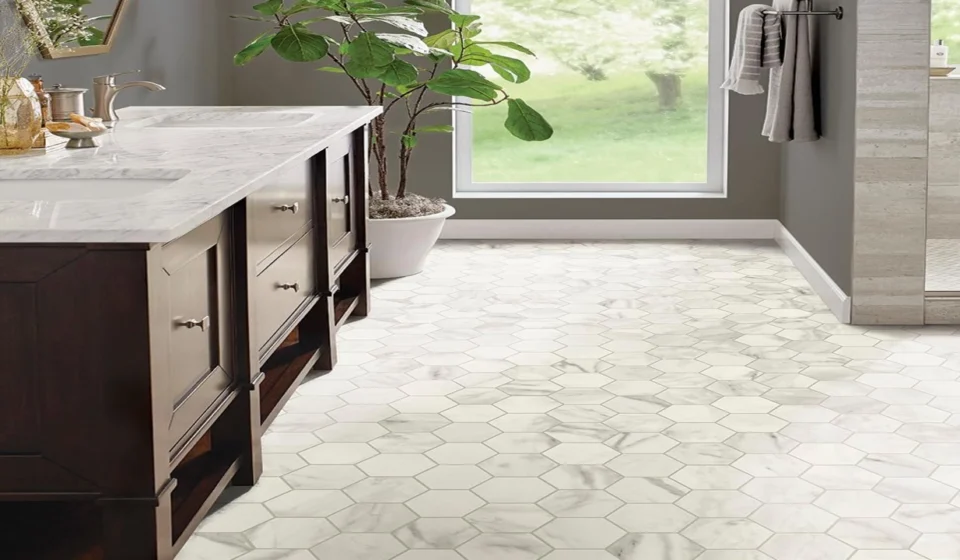
Sheet vinyl flooring is a strong choice for a bathroom because it resists water, and it is easy to keep clean. The wide roll means there are very few seams, and the seams that remain are at the edges, not in the middle of the floor. A coved edge, where the vinyl rises a little up the wall, helps keep water out of corners.
A bathroom should have a flat subfloor, a neat finish at the toilet and bath, and a seal around the door frame. A loose-laid sheet may be enough for a small bathroom, while a glued-down sheet is better for a larger or wetter room.
The floor should feel warm underfoot, and it is a good idea to choose a slip-resistant surface for a bathroom, as wet floors can be slick. A sheet that is textured or embossed is better than a smooth one for a wet area.
Linoleum Flooring Rolls and Vinyl Sheet
Linoleum flooring rolls and vinyl sheet can look alike at first glance, yet they are made from different materials. Linoleum is made from natural materials like linseed oil, wood flour, cork, and limestone pressed onto a jute backing. Vinyl sheet is made from plastic layers, mostly polyvinyl chloride, backed by felt or fibreglass.
The two floors behave differently in real rooms. Vinyl sheet is easier to care for, as it resists stains and water and needs little upkeep. Linoleum can be damaged by water if it is left to stand, and it may need sealing from time to time to keep its surface safe. Linoleum is also more brittle than vinyl sheet, so it may crack if a heavy object is dropped on it.
The difference between the two floors shows up in how long they last in a wet room and how much work they take to keep clean. Vinyl sheet is the simpler choice for a bathroom, a kitchen, or a laundry room. Linoleum is often chosen for homes where natural materials matter more than water resistance.
If you are trying to decide which floor suits your room, compare the costs, care, and lifespan of both. Sheet vinyl is often cheaper to buy and easier to fit, while linoleum may last longer in a dry room and may cost more to fit. Choose the one that suits the way you use the room.
Where to Find Wide Sheet Vinyl
Where to find wide sheet vinyl depends on the size you need. Most flooring stores carry 6-foot and 12-foot rolls in a good range of patterns, though the widest rolls are often special order. Online flooring retailers may stock a wider range and can often deliver to your door.
To find the right width, measure the room in both directions, then pick the widest roll that will cover it in one piece. If the room is wider than the roll, you may need a seam, and the seam should be placed where it will not be seen or walked on much.
Who sells 16 foot wide vinyl flooring? The widest rolls are usually sold by specialist flooring stores and larger online flooring retailers. Many small general stores do not stock them, because sixteen-foot rolls are heavy and take up space. If you need this width, call ahead and ask about ordering, delivery time, and installation.
Who sells 14 foot wide vinyl flooring? Fourteen-foot rolls sit between the common twelve-foot size and the wider fifteen-foot and sixteen-foot sizes. Some flooring stores and online retailers carry them in a smaller range of patterns. Others can order them on request, so ask which patterns are available in fourteen feet. A special order can take longer than a stocked size.
The best way to find the right size is to ask a flooring store what they stock and what they can order. A good store can also help you choose the pattern, the wear layer and the backing that fits the room. When you compare prices, remember to include delivery, install, and seam costs, so you can see the full price. The page on the best vinyl flooring has more comparisons of formats and prices.
FAQ: Vinyl Sheet Flooring
What is vinyl sheet flooring?
Vinyl sheet flooring is a large roll of flexible vinyl that covers a room in one or two pieces, with very few seams.
Is vinyl sheet flooring good for a bathroom?
Yes. Sheet vinyl is good for a bathroom because it resists water, it has very few seams, and it is easy to clean. Seal the edges and keep the floor dry.
What widths does vinyl sheet flooring come in?
Most rolls are 6, 12, or 15 feet wide, although some brands also offer 13 and 14 feet.
Who sells 16 foot wide vinyl flooring?
The widest rolls are generally sold by specialist flooring stores and large online retailers. Many small stores do not stock them, due to weight and cost, so they may need to order one in for you.
Who sells 14 foot wide vinyl flooring?
Fourteen-foot rolls are carried by some flooring stores and online shops. If a store does not stock them, ask about a special order.
How is vinyl sheet flooring different from linoleum?
Vinyl sheet is made from plastic and is easy to care for, while linoleum is made from natural materials and needs more care, especially in wet rooms.
Flooring Cost Breakdown Calculator
See what a flooring job really costs — line by line. Enter your room and your prices, and get the material, labor, underlayment, trim and removal costs separately, not just one lump sum.
3 steps
- Step 1 — Measure: measure the room length and width in feet and inches.
- Step 2 — Price: enter the price per square foot for material, labor and underlayment, plus trim and removal.
- Step 3 — Check the breakdown: read each cost line, then the estimated total at the bottom.
Your cost breakdown will appear here. Fill in the room size and prices above, or press the example button.
Shop on Amazon (optional)
We do not recommend a specific product. Search Amazon yourself for the flooring you want.
As an Amazon Associate, we earn from qualifying purchases.
Save this estimate
How each cost line is worked out
First the tool works out the room area. A room of 12 ft by 15 ft is 180 sq ft. Then it adds waste only to the material, because you buy extra boards for cuts, but you do not pay labor for boards that end up as offcuts.
- Net area = length × width, with inches converted as feet + inches ÷ 12.
- Order area = net area × (1 + waste ÷ 100).
- Material cost = order area × material price per sq ft.
- Labor cost = net area × labor price per sq ft.
- Underlayment cost = net area × underlayment price per sq ft.
- Trim cost = trim length in linear ft × trim price per linear ft.
- Total = material + labor + underlayment + trim + removal.
- Total per sq ft = total ÷ net area.
Worked example A — the example button
Room 12 ft × 15 ft = 180 sq ft net. Waste 10% gives an order area of 198 sq ft. Material at $3.49 per sq ft is $691.02. Labor at $2.50 per sq ft on 180 sq ft is $450.00. Underlayment at $0.50 per sq ft is $90.00. Trim of 50 linear ft at $1.20 is $60.00. Removal is $100. The estimated total is $1,391.02, which is $7.73 per sq ft.
Worked example B — material only
Room area 100 sq ft, waste 0%, material $2.00 per sq ft, and every other price 0. The order area stays 100 sq ft, material cost is $200.00, and the estimated total is $200.00. This is the check to use if you only want a material price and nothing else.
Worked example C — no labor, no removal
Room 10 ft × 10 ft = 100 sq ft net, waste 10% gives 110 sq ft to order. Material at $4.00 per sq ft is $440.00. Underlayment at $0.40 per sq ft on 100 sq ft is $40.00. Trim of 40 linear ft at $1.00 is $40.00. Labor and removal are both 0. The estimated total is $520.00, which is $5.20 per sq ft.
What this calculator does not do
- It does not give a contractor quote or promise an installer price.
- It does not include tax, delivery, stairs, subfloor repair or furniture moving, unless you add those amounts yourself to the removal field or a price field.
- It does not collect your name, email or address, and it does not send your estimate anywhere. Saved projects stay on your own device.
Disclaimer: This is an estimate only, not a contractor quote. Prices vary by product, area and installer.
Frequently asked questions
Is this a contractor quote?
No. This is an estimate only, not a contractor quote. Prices vary by product, area and installer. Use the total to plan your budget, then get a written quote from your installer.
Why is labor charged on the net area but material on the order area?
Labor is paid for the floor you actually cover, so it uses the net room area. Material must cover cuts and waste too, so it uses the larger order area, which is net area plus waste.
Does the total include tax or delivery?
No. Tax, delivery and any permit fees are not included. Add them separately if your store or installer charges them.
What if I do the work myself?
Enter 0 for labor price per square foot. The tool will then show only material, underlayment, trim and removal costs.
What should I put for old-floor removal?
Enter the flat amount your installer charges to remove the old floor, or 0 if there is no old floor to remove or removal is already included in another price.
Can I save more than one estimate?
Yes. Give the estimate a name and save it. You can save up to 10 projects on this device and load any of them later.
Related tools
Conclusion
Vinyl sheet flooring is a simple, effective floor that keeps water out with its few seams, its wide rolls, and its easy care. Its patterns range from wood and stone to bold designs, and it suits a wide range of rooms.
Choose a width that covers the room well, pick a pattern that fits the room, and give the floor a flat, dry base to sit on. Then, with a neat seam and tidy edges, your room will look like one smooth, clean surface.