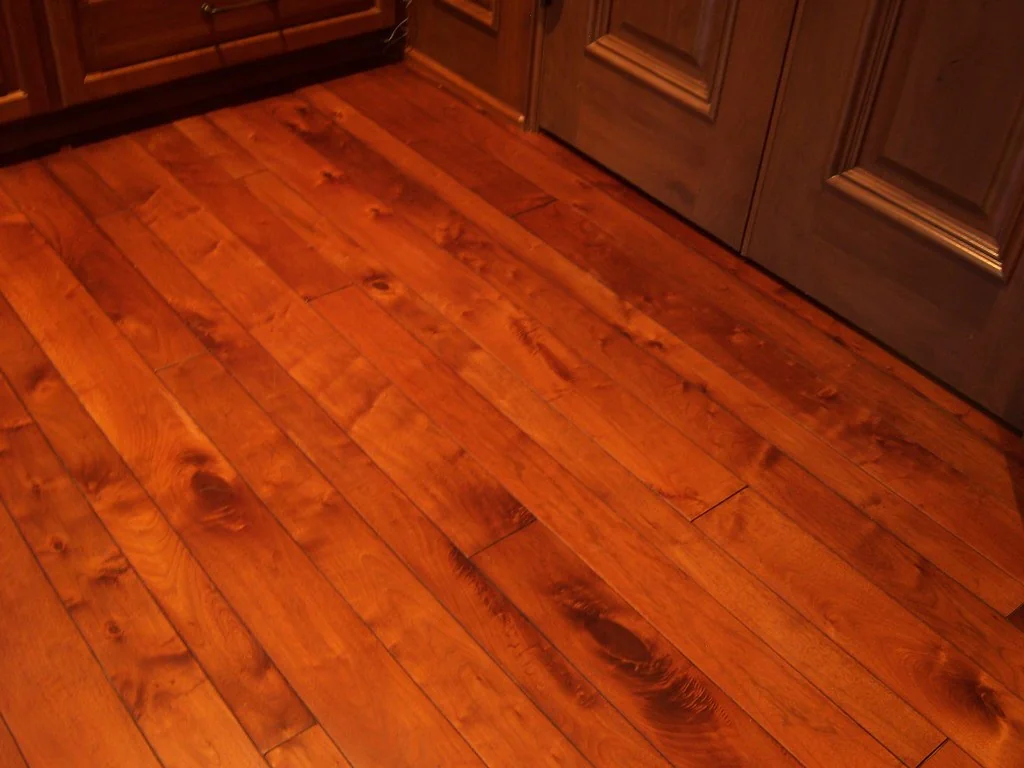

Wood parquet flooring is a wood floor made from small pieces of wood arranged in repeating geometric patterns. The most common design is herringbone, where narrow blocks of wood meet at a right angle to form a zig-zag. Chevron, basketweave, and mosaic patterns use the same idea.
Because the grain changes direction from piece to piece, wood parquet flooring looks planned and decorative even in a plain room. That is why it is often chosen for living rooms, dining rooms, and entryways.

| Pattern | Look | Waste and Install Difficulty | Best Rooms |
|---|---|---|---|
| Herringbone | Zig-zag blocks at right angles, classic and lively | More waste and slower to lay | Living rooms, dining rooms, hallways |
| Chevron | V-shaped points that lead the eye forward | More waste, cuts on the angle | Hallways, large living rooms |
| Basketweave | Small squares that weave over and under | Less waste, easier to lay | Bedrooms, studies, small rooms |
| Straight plank | Long parallel boards, calm, and open | Low waste, easy to lay | Bedrooms, kitchens, large rooms |
Herringbone, Chevron, Basketweave and Mosaic Wood Parquet Patterns
Herringbone is the best-known parquet pattern. Narrow blocks are laid at a right angle to each other to form a zig-zag row. The pattern works in a large room and adds movement to a floor without adding color. Because the grain changes direction from block to block, the wood can look darker in one row and lighter in the next as the light changes. That is part of the charm of herringbone floors.
Chevron is similar to herringbone, but the blocks are cut at an angle to meet in a V shape. The pointed tips make a room look longer and draw the eye forward. They suit hallways and large living rooms. Chevron usually wastes more wood than herringbone, as each block must be cut at the same angle.
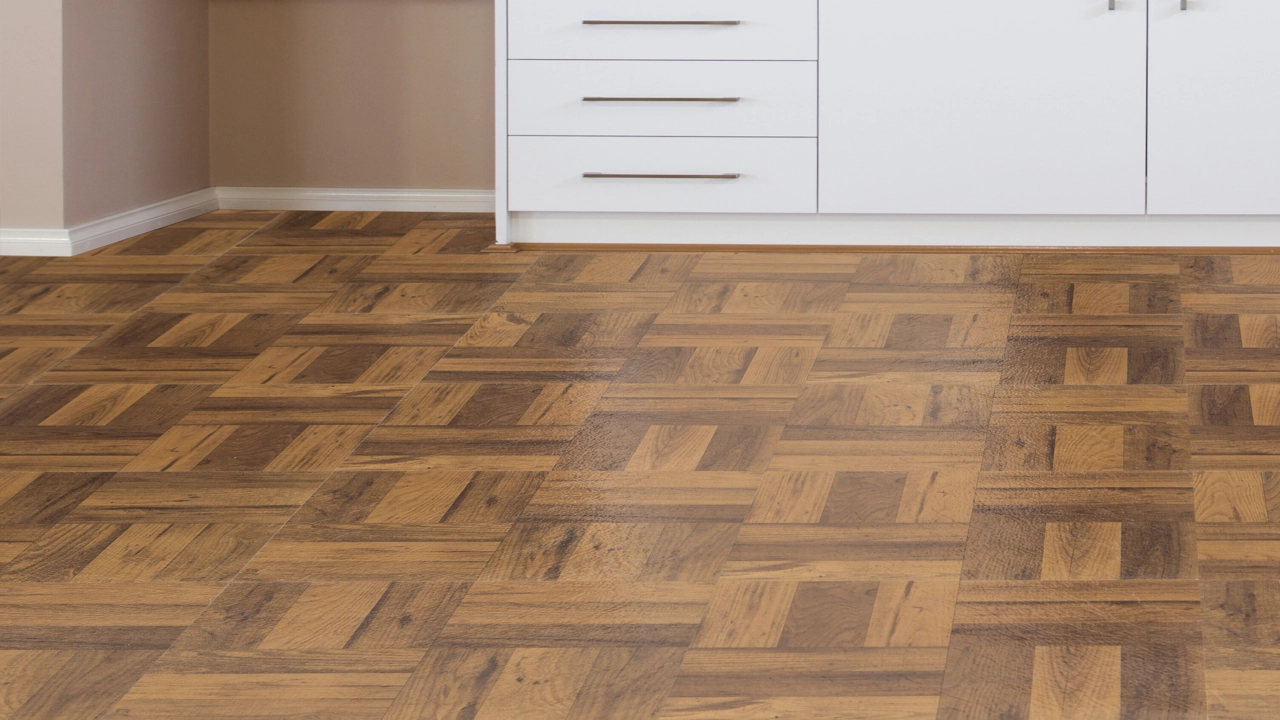
Wood parquet flooring also uses simpler patterns. Basketweave is small squares of wood that appear to weave over and under each other. Mosaic is a factory-made square panel with small pieces in a fixed pattern. Basketweave and mosaic patterns are easier to install and waste less wood than herringbone or chevron.
Wood parquet flooring comes in a range of wood types. Pale oak makes the pattern easy to see in a bright room without overpowering it. Dark walnut makes the pattern look bolder, but the room needs good light. Engineered planks in light colors are worth comparing, as a patterned vinyl floor can offer a similar look for less money, and you can compare parquet vinyl flooring options before choosing.
Solid Wood Parquet vs Engineered Wood Parquet
Solid wood parquet flooring uses whole blocks of wood laid one by one. Engineered wood parquet flooring uses a thin veneer of real wood over a ply base. Both look the same once installed, but they behave differently in real homes. Engineered planks tend to be more stable, but they can be noisier than solid underfoot when walked on, and they cannot be sanded as many times over a lifetime.
Choose solid wood parquet flooring if the room is dry, stable, and not over a damp slab. It can be sanded and resealed many times over a lifetime. Choose engineered wood parquet flooring if the room is over concrete, or if it is near a kitchen. Engineered blocks are less likely to cup, and they can be used in more rooms than solid ones.
Solid wood parquet flooring often uses an oak, walnut, or maple block that is easy to source in standard sizes. Engineered wood parquet flooring uses similar veneer in the same wood types.
Wood Parquet Flooring Pros and Limits
Wood parquet flooring makes a room look planned and decorative. It hides small scuffs better than a straight plank floor because the grain changes direction from block to block. The pattern draws the eye away from small marks, so the floor can look well kept for longer. The pattern is also timeless, which means it suits both classic and modern rooms.
The same pattern has limits. A parquet floor often costs more per square foot than a straight plank floor because the layout is slower and there is more waste. The blocks themselves may not cover a large room as quickly as planks. Wood parquet flooring also needs a flat subfloor, and the installer will take more time than with a simple straight lay.
Costs and install time will be higher for a complex pattern than for a simple one. Herringbone and chevron cost more than basketweave and mosaic. The wood will also need the same regular care as any wood floor. A parquet floor can be sanded and resealed, but the floor will look its best if it is swept and cleaned regularly.
Best Rooms for Wood Parquet Flooring
Wood parquet flooring works best in rooms where the pattern can be seen. Living rooms, dining rooms, and hallways suit it well, as a large floor area makes the pattern look deliberate. It can also work in bedrooms and studies if the pattern is quieter, like basketweave or light herringbone.
Kitchens can take it if the floor is engineered wood and it is sealed well. It should not be used in full bathrooms or wet rooms, as the wood can swell and buckle. A hallway with no doors to the outside is a better fit for a patterned floor than a wet room.
Bedrooms suit a quieter basketweave or pale herringbone. The pattern should be visible, but it should not distract. If you have a small room, choose a pale wood and a small block to make the space look larger.
How Much Does Wood Parquet Flooring Cost?
Wood parquet flooring is more expensive than straight plank wood flooring. Solid wood parquet flooring often costs $8–$15 per sq ft for materials, not including installation. Engineered wood parquet flooring often costs $12–$25 per sq ft for materials. The cost of installation may be higher than a simple floor because the layout takes longer and there is more waste.
Installation and materials for a herringbone or chevron floor often cost more per square foot than a basketweave or mosaic floor, as the cutting is slower and there is more waste. A small bathroom may be quieter than a large floor, but the material cost is still higher per square foot.
For a rough budget, multiply the length of the room by its width to find the floor area, then add the cost of materials, install time, and waste. Add 10–15% extra for waste and cuts if the pattern is simple, and 15–20% extra if the pattern is herringbone or chevron. Use a flooring box calculator to work out how many boxes are needed for your room. Always ask for at least two or three quotes from local installers.
How to Clean and Care for Wood Parquet Flooring
Wood parquet flooring needs regular care to keep it looking good. Sweep and damp mop with a mild wood floor cleaner. Wipe up spills quickly, especially standing water in a kitchen. Do not use a steam mop or flood the floor with water because this can cause cupping or swelling.
Wood parquet flooring can be refinished or recoated, but that process requires sanding or a specialist. If the finish looks dull and the floor is still safe to walk on, it may be easier to have the room re-sealed or the floor simply re-oiled. The floor will look its best if it is swept and vacuumed regularly, with felt pads placed under furniture to prevent scratches.
If a block is damaged, check if the flooring can be replaced. A solid wood parquet flooring block can be replaced, but an engineered one may need to be carefully removed and replaced as well. If the block is damaged or missing, it may be better to call a professional.
FAQ: Wood Parquet Flooring
What is the difference between herringbone and chevron wood parquet flooring?
Herringbone uses rectangular blocks laid at a right angle to form a zig-zag. Chevron uses blocks cut at an angle so that they meet in a V shape. Herringbone looks more casual, while chevron looks more formal and draws the eye forward.
Should I choose solid or engineered wood parquet flooring?
Choose solid wood parquet flooring for a dry, stable room where you want a floor that can be sanded and refinished many times. Choose engineered wood parquet flooring if the room is damp, over a concrete slab, or if you need a more stable floor that can tolerate moisture.
How do you clean wood parquet flooring?
Sweep or vacuum with a soft brush attachment, then damp mop with a wood floor cleaner. Wipe up spills quickly. Do not use a steam mop or flood the floor with water. Vacuum the floor at least weekly and sweep it daily to reduce fine dust and grit, which can cause small scratches.
Can you refinish wood parquet flooring?
Yes, in many cases wood parquet flooring can be refinished. A solid wood parquet floor can be sanded and refinished over and over as long as there is enough wood above the tongue and groove. An engineered wood parquet floor can be refinished once or twice depending on the thickness of the veneer. If in doubt, ask a professional installer to check the floor.
Home > Tools > Flooring Box Calculator
Flooring Box Calculator
Enter your room size, pick a material, add waste, and find out how many boxes to buy. Free, no sign-up.
- Step 1 — Measure: measure the length and width of your room with a tape measure.
- Step 2 — Choose: choose what flooring you are buying and how it will be laid.
- Step 3 — Check the box: type the coverage written on your flooring box, and the answer appears.
No account, no payment, no technical knowledge needed. If you get stuck, press "Fill in an example" below and change the numbers to yours.
Step 1 — How big is your room?
How to measure: stand at one wall and measure to the opposite wall — that is the length. Then measure the other two walls — that is the width. Write feet and inches separately. Example: if the tape shows 12 feet 6 inches, type 12 in Feet and 6 in Inches.
Not sure where to start? Press the example button, see the answer, then change the numbers to your own room.
Any area to skip? (optional)
Example: a fireplace base or a fixed wardrobe that will NOT get new flooring. Leave this empty if the whole room gets flooring — most people leave it empty.
Step 2 — What are you buying, and how will it be laid?
Changing the material only changes the suggested waste percentage. Always follow your product's installation guide.
Step 3 — Check your box, then see the answer
Look on the box label. Example: if the box says "20 sq ft", type 20. Do not guess — every box is different. Without this number, the calculator can show the area but cannot tell you how many boxes to buy.
Only if you want a material-cost estimate. If you leave it blank, you still get the box count. Labor, underlayment and trim are not included here.
Save this project
Projects are saved in this browser only. No account, and nothing is sent to a server.
Your result
Enter a room size to see your result.
Totals are calculated before rounding. Displayed values are rounded to 2 decimal places.
Shop on Amazon (optional)
We do not recommend a specific product. Search Amazon yourself for the flooring you want.
As an Amazon Associate, we earn from qualifying purchases.
How to measure your room
Measure length and width in feet and inches, wall to wall, for each room. For an L-shaped room, split it into two rectangles that do not overlap, measure each one, and add them together. Measure closets and fixed features separately only if they will not receive flooring, and enter those as deductions.
How the calculation works
Net area = sum of room areas − deductions. Order area = net area + waste allowance. Boxes = order area ÷ coverage per box, rounded up to the next whole box, because you cannot buy part of a box. Two kinds of extra are shown separately: the waste allowance you chose for cuts, and the extra that comes from rounding up to whole boxes.
Worked example
Room 12 ft × 15 ft = 180.00 sq ft. With 10% waste, the order area is 198.00 sq ft. At 20 sq ft per box, you need 10 boxes (200.00 sq ft). The box-rounding extra is 2.00 sq ft, and the total extra versus your floor is 20.00 sq ft. Notice the two extras: 18.00 sq ft is the waste you chose, and 2.00 sq ft is only there because boxes come in whole units. If you add them together in your head as "20% extra", you will misunderstand your own order.
Waste allowance guide
Waste is not a fine or a guess — it pays for real pieces that get cut off and cannot be reused. The table below gives starting points only. Your product's installation guide always overrides these numbers, and a room with many doorways, angles, or short wall runs will need more than a plain rectangle.
| Layout | Starting waste | When it applies |
|---|---|---|
| Straight (planks/tiles in rows) | 10% | Most rectangular rooms, the default in this calculator. |
| Diagonal | 15% | Planks or tiles laid at an angle to the walls — far more edge cuts. |
| Herringbone / chevron | 20% | Patterned layouts where almost every edge piece is cut. |
More worked examples
These three examples use different room shapes, so you can check the calculator against numbers you can verify by hand before trusting it with your own project.
| Project | Net area | Waste | Order area | Boxes |
|---|---|---|---|---|
| Small bedroom, 10 ft × 12 ft, straight, box 20 sq ft | 120.00 sq ft | 10% (+12.00) | 132.00 sq ft | 7 boxes (140.00 sq ft) |
| L-shape living room, 20 ft × 15 ft + 10 ft × 8 ft, straight, box 25 sq ft | 380.00 sq ft | 10% (+38.00) | 418.00 sq ft | 17 boxes (425.00 sq ft) |
| Two rooms, 10 ft × 12 ft + 11 ft × 13 ft, straight, box 20 sq ft | 263.00 sq ft | 10% (+26.30) | 289.30 sq ft | 15 boxes (300.00 sq ft) |
Flooring material notes
Laminate: sold by the box with the coverage printed on the label — that label number is the only coverage figure this calculator accepts, because laminate boxes vary. Keep one spare box if you can: a future repair plank must match the same batch and colour.
Vinyl and LVP: plank sizes vary, so do not convert a vinyl order from a laminate order. Measure in sq ft as usual, then apply the waste percentage for your layout and check the LVP product guide — some manufacturers state their own extra percentage, and theirs wins.
Hardwood and wood: the same area maths applies, but hardwood orders often include extra for board selection and grading. If your supplier recommends a higher waste figure for the grade you bought, use the Custom waste option instead of the defaults.
Tile: this calculator gives you sq ft and boxes. It does not count individual tiles, grout, or adhesive — for tile counts and backsplash measurements, use the Tile Calculator, which is built for tile sizes and patterns.
Carpet: carpet is sold by the square yard, not the square foot (1 sq yd = 9 sq ft). In Carpet mode this calculator shows both, and for stairs you need the Carpet Calculator, because stairs are measured by tread, riser, and step count, not by floor area alone.
What this calculator does not do
It does not price your project in full. Labor, underlayment, trim and baseboards, old-floor removal, and delivery are separate costs — the Flooring Cost Estimator covers those. It also does not convert between square feet and linear feet for baseboards or trim — that is the Square Feet to Linear Feet Converter. Keeping each job on its own page is deliberate: one page that tries to do everything ends up doing none of them well, and search engines treat it as a generic page rather than the best answer for one question.
Common mistakes
- Confusing waste with box rounding: they are two different extras. This calculator shows them on separate lines.
- Entering inches as 12 or more: inches must be 0–11. Convert 12 inches to 1 foot first.
- Forgetting deductions, or using a preset box coverage instead of the coverage printed on your own box label.
Frequently asked questions
How do you calculate square feet for flooring?
Multiply length by width for each rectangular area, add the areas together, subtract any areas that will not receive flooring (deductions), then add a waste allowance. For example, a 12 ft by 15 ft room is 180 sq ft before waste.
How much extra flooring should I buy?
Start with 10% for a straight layout and 15% for a diagonal layout, then round up to whole boxes. Check your product guide, because it overrides any starting percentage here. The calculator shows the waste extra and the box-rounding extra separately, so you can see exactly where the extra comes from.
How many boxes of laminate flooring do I need?
Divide your order area (net area plus waste) by the coverage per box printed on the box label, and round up to the next whole box. This calculator does that step for you — but you must enter the coverage from your own box, because laminate boxes do not all cover the same area.
How much extra LVP flooring should I buy?
Use the same rule as above, starting at 10% for straight layouts, and confirm it against the LVP product guide. Diagonal LVP layouts start at 15%. If the guide states a different figure, use the Custom waste option and enter that figure.
What is flooring waste?
Waste is the extra flooring allowed for cuts at walls, around doorways, and for damaged or unusable pieces. It is a real cost of installation, not a safety margin invented by sellers. It is different from the extra that comes from rounding up to whole boxes.
Do I need to add waste for a straight layout?
Yes. Even a straight layout needs cuts at the edges of every room, so 10% is the usual starting point. A perfectly rectangular room with no doorways still loses pieces at the last row of every wall. Diagonal and herringbone layouts need more because more pieces are cut at angles.
Why are boxes rounded up instead of down?
You cannot buy part of a box, and rounding down would leave you short of the order area. Rounding up guarantees you have at least the order area, plus a small remainder you can keep as spares for future repairs. That remainder is shown as the box-rounding extra, not hidden inside the waste figure.
How do I measure an L-shaped room?
Split the L-shape into two rectangles that do not overlap, measure each rectangle, and add the two areas together. In this calculator, choose L-shape mode and enter both rectangles — the tool adds them and applies waste to the combined area, not to each rectangle separately.
Last updated: 26 October 2026. Waste percentages are starting points; your product's installation guide overrides them.
Related tools
Conclusion
Wood parquet flooring turns a floor into a planned pattern. Herringbone is the most common choice, chevron is more formal, and basketweave is quieter and easier to install. Solid wood parquet gives the best feel and refinishing options. Engineered wood is more stable in damp conditions.
Before you buy, choose a pattern that suits the room, think about the subfloor, and get a quote from a professional installer. If you like the look but want an easier install or a smaller bill, a vinyl parquet look is an easier option. The right pattern will make the room look and feel better for years.