


A chipped porcelain tile in a bathroom looks worse every day. Porcelain is unforgiving: hard, brittle, and tricky to replace without disturbing the tiles around it. A good repair kit fills the chip or crack in place, blends the color, and cures into a hard surface that handles daily foot traffic.
We compared the most-listed tile repair kits against one requirement: made for porcelain and ceramic tile. We checked the repair formula, the color-matching system, whether the cured repair stands up to bathroom moisture, and what is in the box. Anything built only for bathtubs or fiberglass was removed, leaving six picks suited to porcelain bathroom floor tile.
Below you will find a quick verdict and a comparison table. Then come full reviews of each pick with honest drawbacks, plus practical guidance on formulas, color matching, and when a repair beats a replacement. If the damage runs deeper than a surface chip, our guide to shower floor tile can help you weigh whether replacement is the better call.
Quick Verdict
Best Overall: Ankita Tile Repair Kit for Chips & Cracks — two-part epoxy with an eight-pigment system that handles most porcelain chip repairs on floors and walls.
Best Budget: Nozerix Porcelain Repair Kit (160g) — squeeze-tube control and a full pigment set that keeps small one-chip jobs simple and cheap.
Best Premium: Hupeyna Tub, Tile and Shower Repair Kit — the widest color palette of the group, aimed at repairs you want to disappear.
Quick Comparison Table
| Product | Award | Key Spec | Price |
|---|---|---|---|
| Ankita Tile Repair Kit for Chips & Cracks | Best Overall | Type: Two-part epoxy; 8 pigments; sandable non-shrinking cure | Check Price on Amazon |
| Nozerix Porcelain Repair Kit, 160g | Best Budget | Type: Squeeze-tube waterproof kit; pigments, tools, instructions included | Check Price on Amazon |
| COCONIX Tile & Ceramic Repair Kit | Best Value | Type: Kneadable epoxy putty; full color spectrum; all-in-one box | Check Price on Amazon |
| Bellemora Porcelain Repair Kit | Best Multi-Surface | Type: Porcelain repair kit; enamel, acrylic, porcelain, ceramic; 24h cure | Check Price on Amazon |
| Hupeyna Tub, Tile and Shower Repair Kit | Best Premium | Type: Porcelain repair kit; wide color palette; few-step application | Check Price on Amazon |
| Vigorder Tile Repair Kit | Best for Color Matching | Type: Ceramic tile kit; 10 shades + mixing guide; crack fillers + putty | Check Price on Amazon |
The Picks
1. Ankita Tile Repair Kit for Chips & Cracks, Ceramic & Porcelain — Best Overall
 Check On The Amazon.com
Disclosure: As an Amazon Associate, I earn from qualifying purchases.
| Type | Two-part epoxy tile repair kit |
| Surfaces | Ceramic and porcelain tile, floor and wall |
| Color system | 8 pigments: white, off-white, gray, beige, almond, more |
| Cured finish | Hard, non-shrinking, sandable |
| Process | Mix Parts A + B, add pigment, fill, smooth before curing |
✅ Reasons to buy
- Two-part epoxy cures into a hard, non-shrinking fill that stands up to bathroom foot traffic
- Eight-pigment system lets you blend gradually toward common porcelain shades
- Fills chips, cracks, holes, and damaged edges, then sands flush with the surrounding tile
- Made for both floor and wall tile, so one kit can cover a whole bathroom
❌ Reasons to avoid
- Mixing and tinting takes more hands-on work than a ready-made squeeze tube
- Patterned or speckled tiles still need a test patch to check the color blend
- No stated kit weight, so estimating how many chips it covers takes some guesswork
Ankita takes Best Overall because it pairs the strongest repair chemistry on this list with the most flexible color system. The two-part epoxy bonds to the damaged spot and hardens without shrinking or pulling away from the edges. The eight-pigment set covers the white, off-white, gray, and beige range that most porcelain bathroom tiles sit in.
It fits homeowners who want one kit that handles chips, hairline cracks, and edge damage on both floors and walls. Skip it if you would rather avoid mixing entirely — the squeeze-tube pick below is the lower-effort option, trading color control for simplicity.
2. Nozerix Porcelain Repair Kit, Waterproof, 160g — Best Budget
 Check On The Amazon.com
Disclosure: As an Amazon Associate, I earn from qualifying purchases.
| Type | Waterproof porcelain tile repair kit |
| Size | 160g |
| Form | Squeeze tube |
| Color system | Advanced pigment blending for natural color matching |
| In the box | Pigments, tools, step-by-step instructions |
| Surfaces | Porcelain, ceramic, marble, granite, quartz, fiberglass, acrylic |
✅ Reasons to buy
- Squeeze-tube form gives controlled application on cracks, chips, and edges with little mess
- Pigment blending system helps the repair sit naturally against surrounding porcelain
- Cured layer resists water and daily cleaning, which suits bathroom use
- Ships with pigments, tools, and instructions, so beginners need no extra gear
❌ Reasons to avoid
- At 160g it is sized for a few small repairs, not a whole row of damaged tiles
- Squeeze-tube fills are thinner per pass than two-part epoxy on deep chips
Nozerix wins Best Budget by making the simplest job genuinely simple. The squeeze tube places compound exactly where the chip is. The included pigments, tools, and instructions mean there is nothing else to buy. Once cured, the repair forms a water-resistant layer that holds up to mopping and splashes.
It fits renters and first-time DIYers facing one or two small chips who want a quick, contained repair. Skip it if the damage is deep or spread across many tiles — a larger two-part epoxy kit covers that ground more economically.
3. COCONIX Tile & Ceramic Repair Kit — Best Value
 Check On The Amazon.com
Disclosure: As an Amazon Associate, I earn from qualifying purchases.
| Type | Tile and ceramic repair kit |
| Formula | Kneadable epoxy putty |
| Finish | Super-strong, waterproof, durable bond |
| Color range | White, slate gray, terracotta, aqua, sand beige, red, blue, yellow, more |
| In the box | Everything needed for the repair |
| Handles | Chips, cracks, holes, discoloration, stains, broken tiles |
✅ Reasons to buy
- Kneadable putty is easy to mold into the damaged spot and shape before it sets
- Cures into a waterproof, durable bond that suits wet bathroom floors
- Full color spectrum goes well beyond whites and grays into bolder tile colors
- Complete box with no extra shopping trip required
❌ Reasons to avoid
- Putty needs firm hand pressure to seat properly in very fine hairline cracks
- The wide color range is only useful if your tile is not a standard white
COCONIX earns Best Value with a forgiving formula and a color range far beyond the usual bathroom whites. The kneadable putty molds into chips and holes without dripping, then hardens into a waterproof bond. For colored or decorative porcelain tile, the extended palette is a real advantage.
It fits households with several damaged spots or colored tile that a white-only kit cannot match. Skip it if your damage is hairline-thin — a flowable epoxy fills those finer cracks more easily than a putty you have to press in.
4. Bellemora Porcelain Repair Kit — Best Multi-Surface
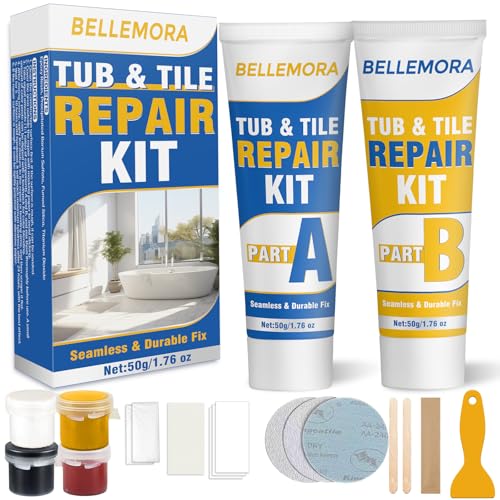 Check On The Amazon.com
Disclosure: As an Amazon Associate, I earn from qualifying purchases.
| Type | Porcelain repair kit |
| Surfaces | Enamel, acrylic, porcelain, ceramic |
| In the box | Repair agents A and B (50g × 2), scraper, 6 stickers, mixing board |
| Mix ratio | 1:1 |
| Cure | 24 hours before sanding |
| Formula | Low odor, environmentally friendly materials |
✅ Reasons to buy
- Works across enamel, acrylic, porcelain, and ceramic, so it covers tile plus nearby fixtures
- Simple 1:1 mix ratio removes measuring guesswork
- Full kit with scraper, stickers, and mixing board included
- Low-odor, environmentally friendly formula for indoor bathroom work
❌ Reasons to avoid
- Needs a full 24-hour cure before sanding, so the bathroom stays out of action longer
- Color options are less documented than dedicated tile-matching kits
Bellemora earns its spot as the multi-surface option. It is a porcelain repair kit that also covers ceramic tile, enamel, and acrylic. That matters in a real bathroom, where a chipped floor tile often sits next to a scuffed sink or tub edge. The 1:1 mix keeps preparation simple, and its adhesion suits surfaces that get touched daily.
It fits homes that want one kit for tile plus porcelain fixtures. Skip it if the bathroom cannot sit unused for a day — the 24-hour cure before sanding is the price of its tougher bond.
5. Hupeyna Tub, Tile and Shower Repair Kit — Best Premium
 Check On The Amazon.com
Disclosure: As an Amazon Associate, I earn from qualifying purchases.
| Type | Tub, tile and shower repair kit with color match |
| Surfaces | Porcelain and more |
| Colors | White, beige, cream, cookie, almond, flax, brown, ice gray, black, blue, red |
| Application | Few simple steps, highly adhesive |
✅ Reasons to buy
- Color palette is the widest here, covering darks and warm tones most kits ignore
- Explicitly made for tile as well as tubs and showers
- Highly adhesive formula built to hold through wet bathroom conditions
- Short step count suits repairs you want finished in one session
❌ Reasons to avoid
- Its tub-and-shower heritage shows — check the tile use case in the listing
- Deep cracks may need a second pass for a level finish
Hupeyna takes Best Premium on the strength of its color range. White, beige, cream, cookie, almond, flax, brown, ice gray, black, blue, and red go far past what a standard kit offers. That matters when the porcelain floor tile is anything but white. The formula was tested and adjusted repeatedly, and it applies in a few steps with strong adhesion.
It fits bathrooms with colored or dark porcelain tile where an invisible repair depends on shade accuracy. Skip it if your tile is a plain white — the standard kits match that shade for less fuss and less money.
6. Vigorder Tile Repair Kit — Best for Color Matching
 Check On The Amazon.com
Disclosure: As an Amazon Associate, I earn from qualifying purchases.
| Type | Ceramic tile repair kit |
| Formula | Ten magic crack fillers + kneadable epoxy putty |
| Cured finish | Smooth, durable, waterproof |
| Shades | 10 classic shades + detailed color-mixing guide |
| Surfaces | Ceramic, porcelain, natural stone, marble, granite, quartz, fiberglass, sinks, bathtubs |
| Guidance | Step-by-step instructions for beginners |
✅ Reasons to buy
- Ten magic crack fillers target hairline cracks that putty alone cannot reach
- Ten classic shades plus a mixing guide give a structured path to an accurate match
- Kneadable putty handles the deeper chips the fillers cannot fill
- Beginner-friendly instructions make it a safe first repair kit
❌ Reasons to avoid
- Two formats in one box means two learning curves on your first repair
- Wide surface compatibility spreads focus beyond porcelain tile
Vigorder is the only pick here that ships two repair formats. Ten magic crack fillers target hairline cracks, while a kneadable epoxy putty handles deeper chips. Once cured, the repair is smooth, durable, and waterproof enough for bathroom floors. The ten-shade set plus a detailed mixing guide gives the most structured color-matching help on this list.
It fits first-timers dealing with mixed damage — thin cracks and deeper chips in the same bathroom. Skip it if you only have one small chip; a single-format kit gets the job done with less to learn.
Two-Part Epoxy or Kneadable Putty: Picking the Right Formula
The six picks fall into three formula families, and the right one depends on your damage. Two-part epoxy (Ankita, Bellemora) cures into the hardest, most shrink-resistant fill. It is the strongest choice for porcelain floors because they take direct weight and the repair must sit perfectly flush. The tradeoff is effort: you measure, mix, tint, and smooth before the working window closes.
Kneadable putty (COCONIX, Vigorder) is pressed into shape by hand, like clay. It cannot run or drip, which makes it forgiving on vertical edges and curved damage, and it fills deep chips in one pass. For very thin hairline cracks, though, a stiff putty struggles to penetrate — that is where a flowable epoxy or a dedicated crack filler has the edge.
Squeeze tubes (Nozerix) sit between the two: pre-mixed, easy to place, and ideal for small surface chips. Whatever family you choose, check two things on the listing. First, that the cured repair is sandable — you will almost always need to level the fill flush with the tile. Second, that it is rated waterproof once fully cured, since a bathroom floor sees constant moisture.
Getting the Color Match Right on Porcelain Tile
Color matching decides whether a repair disappears or just looks like a patch. Porcelain tile is rarely a pure flat white. Most tiles carry warm or cool undertones, slight speckling, or a glossy finish that changes how the repair reads. Every kit on this list ships pigments or shades for a reason: the raw filler almost never matches out of the tube.
Work gradually. Add pigment a little at a time and test the blend on a hidden corner first. Ankita’s pigment system and Vigorder’s ten-shade guide reward patience, and COCONIX’s spectrum helps with colored tile. On patterned porcelain, expect a close blend rather than invisibility — the goal is a repair the eye skips over. Our guide to bathroom floor white tiles shows how many whites one “white” bathroom can hold.
Repair or Replace? The Honest Call
A repair kit is the right answer when the tile itself is structurally sound. Surface chips, small impact dents, hairline cracks, and chipped edges are exactly what these kits were designed for. The tile stays bonded and only the glaze is damaged, so a filled, sanded, color-matched repair holds for years under normal use.
Replacement wins when the damage goes deeper. A tile cracked clean through its body will not stay fixed with filler. Neither will a tile that rocks or sounds hollow when tapped, or damage sitting directly under a heavy fixture. Neither will damage caused by subfloor movement — patching hides the real problem. When several tiles are damaged, replacing the section is usually faster than repairing each one.
How Long a Repair Lasts in a Wet Bathroom
Every kit here claims waterproof performance, but that claim only holds after a full cure. Epoxy repairs need the full window the listing states — Bellemora asks for 24 hours before sanding. The area must stay dry and undisturbed until then. Rushing a repair back into service in a steamy bathroom is the most common reason repairs fail early.
Longevity also depends on what surrounds the repair. Grout lines absorb water and can wick moisture under a fresh repair, so sealing the grout around the work is smart maintenance. Our guide to the best grout sealer for shower areas covers sealers that protect both grout and nearby repairs. Once cured and sealed, a well-matched epoxy or putty repair typically outlasts the surrounding grout itself.
Frequently Asked Questions
Can you repair porcelain floor tile without replacing it?
Yes, for chips, small cracks, and edge damage — that is exactly what tile repair kits are for. You fill the damage with an epoxy or putty compound, tint it to match, smooth it flush, and let it cure fully. A tile that is cracked through the body or loose on the floor needs replacing instead, since filler cannot restore structural strength.
Will a porcelain tile repair kit make the damage invisible?
It can come close on solid-color tiles, but invisibility depends on the tile. A careful pigment blend on a matte, single-color porcelain floor can make a chip nearly undetectable at standing height. Patterned, veined, or high-gloss tiles are harder. The repair will usually read as a close blend rather than a perfect match, though it still looks far better than an open chip.
How long does a tile repair kit take to cure?
It varies by formula, and the listing is the authority — always follow it. Two-part epoxies commonly need several hours to set and a full day before sanding or heavy use, with Bellemora specifying 24 hours before sanding. Keep the repaired area dry and undisturbed for the entire cure window; moisture during curing is the fastest way to weaken a repair.
Can I use a tile repair kit on a shower floor?
Yes, once the repair is fully cured and the formula is rated waterproof — every pick on this list meets that bar. The shower floor is one of the most demanding spots, with constant water and foot traffic. Give the cure window its full time and seal the surrounding grout. If several shower tiles are damaged, replacement may be the more durable route.
How do you match the repair color to porcelain tile?
Start from the filler’s base and add pigment gradually, testing the blend on a hidden spot before applying it. Kits like Ankita’s and Vigorder’s give you multiple pigments or shades plus mixing guidance precisely for this. Porcelain whites carry undertones — gray, beige, almond — so compare your test patch in the room’s actual light, since bathroom lighting shifts how whites read.
What damage is a repair kit not suitable for?
Kits are not suitable for tiles that are cracked through, loose, or hollow-sounding when tapped — those are structural failures that filler cannot fix. They also cannot fix damage caused by a moving or water-damaged subfloor; the tile will keep cracking no matter how well you patch it. In those cases, lift the tile and fix the underlying problem first.
🧱 Free Tool: Tile & Grout Calculator
Tile count, grout bags and thinset bags — calculated for your room.
Conclusion
For most porcelain bathroom floors, the Ankita Tile Repair Kit for Chips & Cracks is the strongest all-round choice. It brings hard-curing epoxy, a real pigment system, and coverage for both floors and walls. The Nozerix 160g kit is the sensible budget route for a single small chip. Hupeyna earns its premium with a color palette that can match tile other kits cannot.
Whatever you choose, the formula matters less than the follow-through. Clean the damage well, blend the color patiently, and respect the full cure time. Once the repair is set, the floor is ready for daily life again. If the repair has you thinking about grip underfoot, our look at anti-skid shower floors is worth a read next.


