


Floor paint is the one renovation where the chemistry matters more than the colour, and where most purchases go wrong before the tin is opened. A wall paint rolled onto a floor scuffs within a fortnight; an exterior driveway paint seals a bedroom in solvent fumes. Each surface and each room asks for a specific resin, sheen, and preparation ritual.
Five paints are compared here by the surface they bond to and the traffic they survive. The set spans an interior kit for wood and vinyl rooms, a one-part epoxy for budget concrete, and a five-gallon acrylic for large slabs. A polycuramine kit covers premium garage work, while a semi-gloss acrylic crosses indoors and out.
The guide below decodes the resin types, the sheen decision that shows or hides every scuff, the prep steps that decide adhesion, and honest cure-time maths. Painted concrete is a deep lane of its own; our concrete floor paint guide drills into that surface specifically.
Quick Verdict
Best Overall for Rooms: Rust-Oleum Home Interior Floor Coating Kit — the true interior kit for tile, vinyl, concrete and wood
Best Budget Concrete: KILZ 1-Part Epoxy Concrete & Garage Floor Paint — single-part epoxy simplicity per gallon
Best for Large Slabs: Rust-Oleum Concrete & Garage Floor Paint, 5 Gallon — paint-and-primer coverage across two-car footprints
Best Premium Garage: Rust-Oleum RockSolid Polycuramine Kit — the heavy-duty cure with decorative chips included
Best Indoor-Outdoor Mix: SENVEN Acrylic Concrete & Garage Floor Paint — one semi-gloss formula for porches, slabs and decks
Quick Comparison Table
| Product | Award | Key Spec | Check Price |
|---|---|---|---|
| Rust-Oleum Home Interior Floor Semi-Gloss Black Coating Kit, 2 Quarts | Best Overall for Rooms | Interior walk-on finish for tile, vinyl, concrete and wood, semi-gloss, 2 qt | Check Price on Amazon |
| KILZ 1-Part Epoxy Concrete & Garage Floor Paint, Slate Gray, 1 Gallon | Best Budget Concrete | Single-part epoxy for concrete and garage floors, slate gray, 1 gal | Check Price on Amazon |
| Rust-Oleum Concrete & Garage Floor Paint, Battleship Gray, 5 Gallon | Best for Large Slabs | Paint and primer in one, resists hot tires and chemicals, UV-resistant, 5 gal | Check Price on Amazon |
| Rust-Oleum RockSolid Garage Floor Coating Kit, Polycuramine, 2.5 Car | Best Premium Garage | Polycuramine coating, no hot-tire pickup, drive-on in 36 hours, chips included | Check Price on Amazon |
| SENVEN Acrylic Concrete & Garage Floor Paint, Light Gray, 1 Gallon | Best Indoor-Outdoor Mix | Interior/exterior acrylic for basements, porches, driveways and decks, semi-gloss | Check Price on Amazon |
The Picks
1. Rust-Oleum Home Interior Floor Semi-Gloss Black Coating Kit, 2 Quarts — Best Overall for Rooms
 Check On The Amazon.com
Disclosure: As an Amazon Associate, I earn from qualifying purchases.
| Surfaces | Tile, vinyl, concrete, wood |
| Finish | Semi-gloss black |
| Size | 2 quarts |
| Use | Interior rooms |
| Cure | Days to full hardness |
| Best for | Decorative floor makeovers |
✅ Reasons to buy
- A rare interior-rated formula legal for bedrooms and living spaces
- Bonds across four surface families where most paints claim one
- Semi-gloss wipes clean without the mirror glare of gloss
❌ Reasons to avoid
- Two quarts cover accents and small rooms, not halls
- Black demands flawless prep, since dust telegraphs forever
This is the answer to the question the category dodges: what can actually go on a kitchen or bedroom floor. The kit is rated for interior living space across tile, vinyl, concrete and wood. That makes it the only pick here for a dated tile floor waiting for a colour decision rather than a repair.
Small-capacity honesty applies: treat it as a room-scale or feature-scale product. Dark semi-gloss over imperfect prep becomes a mirror for every grain of dust, so the sanding and cleaning ritual is not optional with this one.
2. KILZ 1-Part Epoxy Concrete & Garage Floor Paint, Slate Gray, 1 Gallon — Best Budget Concrete
 Check On The Amazon.com
Disclosure: As an Amazon Associate, I earn from qualifying purchases.
| Resin | 1-part epoxy |
| Surfaces | Concrete, garage slabs |
| Size | 1 gallon |
| Finish | Slate gray |
| Mixing | None, stir and roll |
| Best for | Budget concrete refresh |
✅ Reasons to buy
- Single-part formula skips the two-can mixing race against time
- Epoxy toughness at the category’s entry price
- One gallon handles a decent workshop or laundry slab
❌ Reasons to avoid
- One-part epoxies cure softer than true two-part systems
- Hot tires will lift it; garage parks need the premium pick
For a basement slab, utility room, or shed floor, this is the rational buy. It brings real epoxy chemistry without the two-part mixing ritual that burns half the pot life. Stir, roll, done, and the gallon scale matches most small concrete projects without leftovers.
The softness ceiling is real, and the maker does not hide it: this is foot-traffic epoxy, not hot-tire ceramic-melting armor. Concrete priming steps and moisture tests still apply, covered in the guide below.
3. Rust-Oleum Concrete & Garage Floor Paint, Battleship Gray, 5 Gallon — Best for Large Slabs
 Check On The Amazon.com
Disclosure: As an Amazon Associate, I earn from qualifying purchases.
| Resin | Acrylic, paint+primer |
| Surfaces | Concrete, garage slabs |
| Size | 5 gallons |
| Coverage | Two-car garage scale |
| Extras | Hot tire, chemical, UV resistance |
| Best for | Big driveways and shop floors |
✅ Reasons to buy
- Paint-and-primer in one removes a whole coat from the schedule
- Five-gallon pail paints a two-car garage without seams from batching
- Hot-tire and chemical resistance suits working garages
❌ Reasons to avoid
- Single coat ambition still needs perfect cleaning underneath
- Battleship gray is the only honest colour choice here
Large slabs punish small tins, because every new gallon is a fresh chance for a colour seam across the floor. The five-gallon pail solves that, and the built-in primer removes a pass with the roller on day one. For driveways, patios and shop floors, this is the workmanlike route.
Its acrylic chemistry breathes better than true epoxies on slabs with slight moisture history, though a vapour test remains mandatory before any bonded coating. The colour is what it is, and working floors rarely mind.
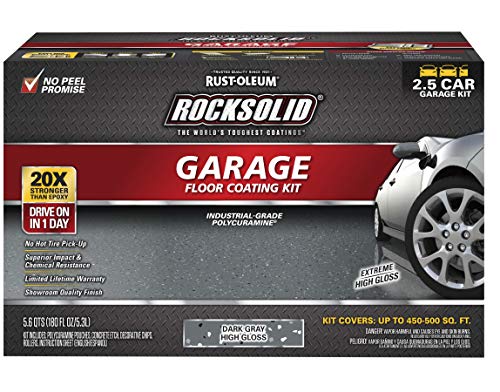
4. Rust-Oleum RockSolid Garage Floor Coating Kit, Polycuramine, 2.5 Car — Best Premium Garage
 Check On The Amazon.com
Disclosure: As an Amazon Associate, I earn from qualifying purchases.
| Resin | Polycuramine |
| Surfaces | Garage concrete |
| Coverage | 2.5-car kit |
| Extras | Decorative chips included |
| Cure | Drive-on in 36 hours |
| Best for | Garage showpiece floors |
✅ Reasons to buy
- Polycuramine out-toughs epoxy on impact, chemicals and hot tires
- Chips in the box create the flake-floor look without a second purchase
- Fast cure returns the garage to parking within two days
❌ Reasons to avoid
- Premium cost per square foot of the category
- Mixed pot life demands the whole floor be planned before opening
The garage floor derby has a clear winner’s circle, and polycuramine sits at its top. It is tougher than epoxy resins on impact and hot-tire pickup, with a cure chart that lets the car back in after a weekend. The included chips finish the floor in one pass instead of three purchases.
Respect the pot life: this is a same-day, whole-floor pour with a helper, not a casually interrupted weekend project. Slabs must pass the moisture test first, or the toughest resin on earth lifts as one giant flake.
5. SENVEN Acrylic Concrete & Garage Floor Paint, Light Gray, 1 Gallon — Best Indoor-Outdoor Mix
 Check On The Amazon.com
Disclosure: As an Amazon Associate, I earn from qualifying purchases.
| Resin | Acrylic |
| Surfaces | Concrete, decks, porches |
| Size | 1 gallon |
| Rating | Interior and exterior |
| Finish | Semi-gloss |
| Best for | Covered porches and mixed zones |
✅ Reasons to buy
- One tin legally crosses the threshold from basement to porch
- Semi-gloss sheds rain and hose water on exterior slabs
- Acrylic flexes with seasonal slab movement better than brittle resins
❌ Reasons to avoid
- Acrylic scuffs sooner than epoxy under heavy indoor traffic
- Light gray shows mud lines on exterior paths
Some houses have a threshold problem, like a basement that runs out onto a porch slab. Those zones need one chemistry rated for both climates. This SENVEN acrylic carries interior and exterior ratings in the same tin, flexing with temperature swings that crack more brittle coatings.
For heavy indoor use it scuffs earlier than epoxy, so keep it to the mixed zones it is built for. As the one-tin answer for porches, steps, and basement-to-outside runs, it removes a whole decision from the paint aisle.
How We Chose
Paints were sorted by resin chemistry first — acrylic, one-part epoxy, two-part-class polycuramine — then by the surfaces each maker explicitly rates. A can that claims everything usually bonds to nothing, so surface lists were read literally. Interior room kits, concrete specialists, and indoor-outdoor crossovers each earned their slot.
Traffic tolerance was weighted over price: hot-tire pickup, chemical splashes, and scuff cycles separate a floor coating from a floor disappointment. Sheen, coverage per tin, and cure-time honesty completed the scoring, because a paint that claims single-coat miracles rarely survives contact with a real slab.
Acrylic, Epoxy, or Polycuramine
The resin decides the ceiling of the job. Acrylic breathes and flexes, which suits slabs with slight moisture history and covered outdoor zones, at the cost of scuff resistance. Basements with a damp history also read our basement floor paint guide before coating. One-part epoxy hardens harder and needs no mixing race. Polycuramine, a polyurea-urethane hybrid, tops the impact and chemical charts at a premium price.
Match resin to room. Bedrooms and kitchens want the interior kit, basement slabs settle for one-part epoxy, and working garages earn the five-gallon acrylic or the RockSolid tier. Buying up resin you do not need is money; buying down where tires park is a do-over next spring.
Sheen: What Hides and What Shows
Gloss reflects light and every scuff with it. Matte hides flaws but holds dirt in its texture. Semi-gloss splits the difference and wipes clean, which is why nearly every serious floor formula lands there. The sheen decision is maintenance modelling, not decoration.
High-traffic paths and pet zones wear semi-gloss, showpiece rooms can take the glare of gloss, and rough utility slabs suit matte. Resheening with a maintenance coat is normal after years, so the first choice is not a life sentence.
Prep Decides Adhesion, Not the Paint
Eighty per cent of peeling floor paint is a prep failure wearing a product-blame costume. The sequence is non-negotiable: repair cracks, degrease oil spots, etch or abrade slick concrete, vacuum the dust, and prime bare patches. Paint bonds to sound, clean, dry, profiled surface, not to dust.
The tape test after curing settles it: press tape hard and rip it; paint that comes up was never bonded. On previously sealed concrete, the sealer must go first, because no new paint sticks to somebody else’s shut film.
Cure Time Is a Schedule, Not a Suggestion
Floor paints publish three clocks: recoat window, foot traffic, and full cure, and confusing them wrecks finishes. Walking on a floor at day one while it needs seven to harden leaves permanent scuff fossils in the resin. Furniture pads return at a week; rugs wait a fortnight on most systems.
Plan the room’s calendar backwards from the cure chart before opening the tin. Mind the recoat window too, because missing it means sanding the first coat to make the second hold. Garages follow the drive-on figure, never the walk-on one.
Frequently Asked Questions
Can I use regular wall paint on a floor?
No. Wall emulsion lacks the resin hardness and abrasion package for foot traffic and scuffs within weeks. Floor-rated formulas exist for that reason, and the interior kit in this list is the correct entry for rooms.
Is epoxy floor paint worth it for a garage with cars?
Only two-part-class systems, and polycuramine above them. One-part epoxies soften under hot tires, so parked cars need tougher chemistry. The RockSolid tier or an acrylic explicitly rated for hot-tire pickup, like the five-gallon pick here, is the answer.
How long does floor paint take to cure fully?
Typically walk-on overnight to two days, furniture at a week, and full chemical-and-rug cure at seven to fourteen days depending on the system. The tin’s three-clock chart outranks generic advice every time.
Do I need to prime concrete before floor paint?
Bare or patched concrete wants a primer coat or a paint-and-primer formula, and previously painted floors need dulled and spot-primed repairs. Skipping this is the shortest route to peeling at week three.
Can floor paint go over tile or vinyl?
Only with an interior kit explicitly rated for those surfaces, like the Rust-Oleum Home kit here, and after deglossing and cleaning. Standard concrete paints will not bond to vinyl wear layers or glazed tile.
Why is my painted floor peeling?
Almost always prep or moisture: dust under the coat, sealer underneath, or slab vapour pushing from below. Run the plastic-sheet moisture test and redo the failed area with proper surface profile before recoating.
🎨 Free Tool: Paint Coverage Calculator
Enter your room size — see how many gallons you need, coats included.
Conclusion
Buy the resin the room needs. The interior kit serves living surfaces, one-part epoxy covers budget slabs, and the five-gallon acrylic handles big working floors. Polycuramine belongs where tires park, and the crossover acrylic takes porches. Then spend the saved enthusiasm on prep, because the surface under the paint decides everything the paint does.
Honour the three clocks on the tin and the floor ages in years, not months. When the job is concrete-specific, the deeper tile paint guide and our concrete coverage explain the surfaces per-room picks cannot reach.


