

Pressure-treated plywood news to subfloor work changes the screw question: the copper-based treatments that replaced the old arsenic formulas corrode plain zinc fast, which is why the right fastener here is a corrosion-rated structural screw, not whatever deck box is half-full in the garage. Screws also beat nails for this job in the way that matters most at 2 a.m. – no squeaks, because a screw’s threads hold the plywood pressed against the joist instead of letting it work up and down. These are the four fastener systems worth buying in 2026, plus the spacing and length rules that decide whether the floor stays silent.
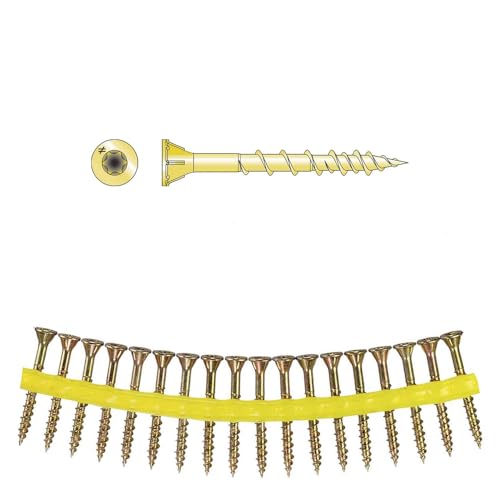
1. Simpson Strong-Tie WSV Subfloor Screws – best overall structural pick
Disclosure: As an Amazon Associate, I earn from qualifying purchases.
| Size | #9 x 2 in. (2,000-ct collated) |
| Coating | Yellow-zinc + rimmed flat head |
| Driver | T-25 6-lobe |
| Best for | Full subfloor sheets over joists |
The WSV line is engineered exactly for this job: the rimmed head with nibs self-countersinks into plywood without over-driving through the face, the shank fils tight without splitting, and the coating handles modern treatments. In collated form it runs through a quota-gun at framing speed. For a whole-room or whole-floor job, this is the pro-spec answer that does not tempt fate. check current price on Amazon
- ✅ Rimmed head with nibs self-countersinks without over-driving through the face
- ✅ Shank grips tight without splitting the plywood
- ✅ Coating handles modern lumber treatments
- ✅ Runs through a collated gun at framing speed
- ❌ Premium price per screw
- ❌ Collated format only pays at real scale
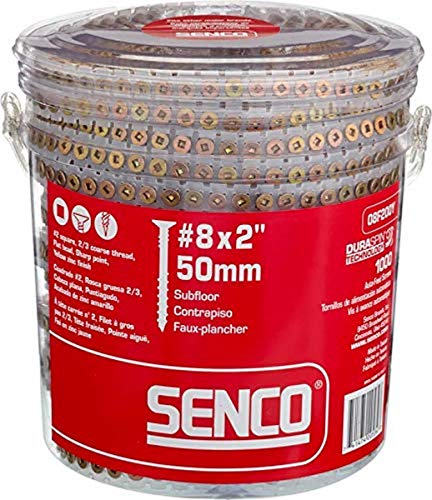
2. SENCO Duraspin #8 x 2 Collated – best for collated screw guns
Disclosure: As an Amazon Associate, I earn from qualifying purchases.
| Size | #8 x 2 in. (1,000-ct tub) |
| Finish | Zinc, flat head |
| System | Duraspin collated guns |
| Best for | Auto-feed tool owners |
If you own (or will rent) a Duraspin auto-feed driver, this is the matching consumable – and the economics of a 1,000-count tub beat boxes of loose screws at any real scale. The #8 x 2 size covers 3/4-inch subfloor to joist penetration, and SENCO’s collation reliability is why crews standardize on it. Buy the screws for the gun you have, not the gun for the screws. check current price on Amazon
- ✅ Purpose-built for the Duraspin auto-feed driver
- ✅ #8 x 2 covers 3/4-inch subfloor-to-joist penetration
- ✅ 1,000-count tub beats loose boxes at any real scale
- ✅ SENCO collation reliability is why crews standardize on it
- ❌ Needs the Duraspin system to make sense
- ❌ Wrong pick if you are driving by hand or a drill
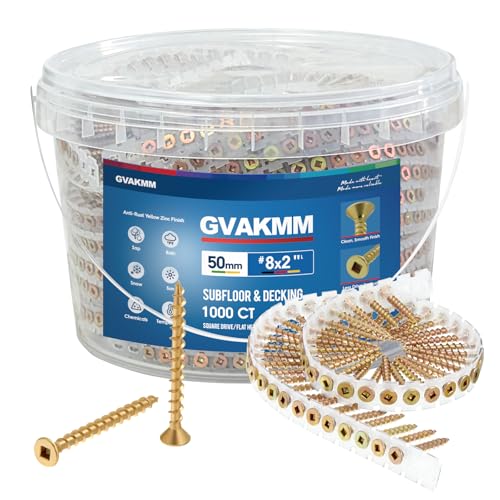
3. GVAKMM #8 x 2 Collated Subfloor Screws – best budget collated value
Disclosure: As an Amazon Associate, I earn from qualifying purchases.
| Size | #8 x 2 in. (1,000-ct bucket) |
| Coating | Anti-rust yellow zinc |
| Head | Square drive flat head |
| Best for | DIY subfloor jobs on a budget |
A thousand collated screws at a DIY price, with the yellow-zinc coating pressure-treated wood requires and a square drive that stays on the bit. Brand trust is the trade-off versus SENCO/Simpson – but for a single room’s worth of subfloor work where the gun is already in hand, the savings bankroll the rest of the project. check current price on Amazon
- ✅ A thousand collated screws at a DIY price
- ✅ Yellow-zinc coating pressure-treated wood requires
- ✅ Square drive stays on the bit
- ✅ The savings bankroll the rest of a single-room project
- ❌ Lesser-known brand with fewer independent reviews
- ❌ Brand trust is the trade-off versus SENCO/Simpson
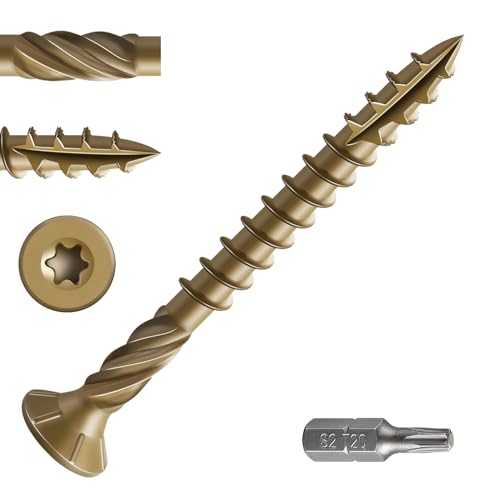
4. Wensilon Epoxy-Coated Deck Screws (#10 x 3) – best for double-layer and thick builds
Disclosure: As an Amazon Associate, I earn from qualifying purchases.
| Size | #10 x 3 in. (137-ct) |
| Coating | Epoxy – treatment-rated |
| Drive | Star T25 |
| Best for | Two-layer subfloors, thick plywood |
When the build stacks – plywood over plywood, or furring strips between – the 2-inch class stops reaching and 3-inch screws take over. Wensilon’s epoxy coating is rated for treated lumber contact, the star drive refuses to cam out, and the count suits spot declines rather than full floors. Keep a box for repairs and transition zones where the fastening gets deeper. check current price on Amazon
- ✅ 3-inch reach for plywood-over-plywood and furring-strip builds
- ✅ Epoxy coating is rated for treated lumber contact
- ✅ Star drive refuses to cam out
- ✅ The fix for transition zones where fastening runs deeper
- ❌ Small 137-ct box suits spot repairs, not full floors
- ❌ Overkill for single-layer work the 2-inch class covers
What We Compared (and What This Is Not)
The four picks come from live Amazon listing data pulled in October 2026, filtered to fasteners explicitly rated for treated lumber and subfloor use, ranked by coating class, head design (nibs and countersinking), collation format and count economics. What this is not: a laboratory test – analysis is research-based on manufacturer specifications and framing-crew practice, stated plainly because fastener “ratings” vary widely between North American and offshore product.
Length and Spacing: The Two Rules That Prevent Squeaks
Length: the screw must pass through the subfloor and penetrate the joist about an inch – so 3/4-inch plywood over 2x joists means a 2-inch screw (the #8/#9 class above), while double-layer builds step up to 3 inches. Spacing: fasten every 6-8 inches along joists and every 12 inches in the field – closer at edges and any seam that lands between joists. The squeak mechanic is simple: plywood that can micro-ride up and down on the joist rubs; screws clamp it still. Glue below the sheet (construction adhesive beads on the joist) plus screws is the permanent combo.
Why Coating Class Decides the Purchase
Modern pressure treatments are copper-rich, and copper eats plain galvanization through electrochemical action – screws sized for untreated lumber rust-and-snap in treated decks within a few seasons. Look for explicit treated-lumber ratings: epoxy-coated, ceramic-coated, or quality yellow-zinc from fastener brands that state compatibility. The premium over unmarked hardware screws is pennies per square foot; the failure it prevents is a subfloor refastening job through a finished ceiling.
The Squeak Repair Playbook for Existing Floors
Most subfloor screw projects are not new construction – they are 2 a.m. squeak hunts under carpet or tile. The playbook: find the joist (stud finder from below if the ceiling is open, or tap-listening from above), drive one test screw at 45 degrees through the subfloor into the joist, and walk-test. If the squeak survives, the noise is between joists – that case wants the short-break screw trick: drive a 2-inch screw through the field until the head seats, which clamps the plywood to nothing in particular but stops plywood-on-joist chatter at deflection points. Carpeted rooms need only a tiny pilot through the pile; hardwood wants a finish-matched plug or a countersunk screw hidden under filler. Ten screws solve most whole-room squeak syndromes – a fifteen-dollar repair against the thousand-dollar refastening nobody schedules.
Collated versus Loose: Which Format Fits Your Job
Loose screws in a box suit repairs – the ten-screw squeak fix, one re-fastened seam, a transition strip. The moment the job becomes a room or a whole floor, collated wins on the only math that matters: cycles per hour. An auto-feed driver sets 1,000 screws without bending twice per screw, which turns a day of kneeling into a morning of standing. The catch is commitment: collated strips lock you to the tool family (SENCO strips in SENCO guns, and so on). Rental counters solve that for one-off floors – rent the gun with the tub of screws, run the project, return both. Buy collated stock only after the tool exists in your kit; until then, loose structural screws by the pound cover every repair scenario.
How many screws does a subfloor sheet actually need?
A standard 4×8 sheet on 16-inch joist centers lands on five joist lines: at 8-inch spacing that is roughly 45-50 screws per sheet, plus the perimeter. A 12×14 room is about five sheets – a few hundred fasteners, which is exactly why collated economics start mattering at single-room scale.
Working With Particle Board and OSB Substrates
Not every subfloor is plywood, and the screw choice shifts with the sheet underneath. OSB – common under carpet in the 1990s stock – has weak face strands: screws hold, but over-driving punches straight through the face layer, so the nibbed-head design earns its keep by stopping at the right depth without judgment. Particle board underlayment is the fragile one: almost nothing holds in its crumbly core, which is why squeaky particle-board subfloors get fixed with longer screws hunting the joist below rather than more screws hunting the panel. When the panel itself is crumbling at fastener lines, the honest repair is panel replacement before any refastening – screws in unreinforced particle board are anchors in sand. Identify your sheet before buying: plywood’s layered edge, OSB’s pressed-strand edge, particle board’s uniform crumb – three materials, three strategies, one screw kit that covers the first two.
Stocking the Kit: What a Real Subfloor Repair Box Holds
The experienced kit is small: one box of #8 or #9 x 2 treatment-rated screws for the joist-line work, a box of subfloor-specific or 3-inch screws for double layers, the T-25 or square driver bits that match (buy three – bits vanish), a countersinking magnetic chuck for clean seating, and a flashlight you trust for joist-finding from below. Add construction adhesive only when a sheet is actually coming up for re-set: the glue-and-screw combo belongs to open-subfloor work, since squirting glue through a tiny gap mostly decorates the subfloor rather than bonding it. Total kit cost sits near one embarrassed handyman invoice – and the flashlight matters more than any fastener, because finding the squeak is the whole repair.
Driving Technique: Seat, Don’t Bury
The best screw fails under a bad trigger finger. Set the driver clutch low and step up until the head just seats flush with nibs touching the face – a head buried a quarter-inch deep adds zero holding power and carves a depression the finish telegraphs. On soft plywood faces, feel for the sudden give that says stop; on OSB, listen for the tone change. Keep the driver square to the sheet – angled screws thread-stripping one side of the pilot hold measurably less in shear. And walk-test every tenth screw on squeak jobs: the clutch setting that seats beautifully on joist lines may under-drive in the field, where only plywood-to-plywood waits below.
How We Chose
Fasteners were compared on the four things that decide subfloor jobs: head design that seats without burying through slim plywood, coating rated for pressure-treated contact, collation format matched to the driver you actually own, and screw geometry that resists cam-out. Availability and pricing come from October 2026 pulls; the guidance is research-based installation practice, not a lab test.
Frequently Asked Questions
Can I use deck screws for subfloor plywood?
Yes if they are rated for treated lumber and long enough – #10 x 3 for double layers, #8/#9 x 2 for single 3/4-inch sheets. Avoid drywall screws entirely: brittle, snap under floor shear, and the classic cause of squeaky repaired-once-twice subfloors.
Do pressure-treated plywood subfloors need special screws?
Yes – copper-based treatments corrode incompatible coatings. Use screws explicitly rated for treated contact: epoxy-coated, ceramic-coated, or quality yellow-zinc structural lines like the WSV. The rating matters more than the brand name.
Nails or screws for subfloor?
Screws for squeak-free clamping; nails for speed on big framing jobs and where code calls for shear values screws complicate. For owner-built or repaired subfloors, screws plus subfloor adhesive is the quiet-for-decades combination.
📐 Free Tool: Flooring Calculator
Enter your room size — see exactly how many boxes you need, waste included.
Conclusion
Pressure-treated plywood subfloors ask for three things: a treatment-rated coating, a Structural-class head that countersinks without tearing, and lengths matched to the stack. The Simpson WSV is the no-compromise pick, SENCO fits auto-feed gun owners, GVAKMM covers budget collated needs, and the Wensilon 3-inch class handles thick builds. Add proper spacing (6-8 inches on joists) and a bead of subfloor glue, and the floor stays silent for the life of the house.
