


The best home gym flooring matches your training, not just your room size. Heavy lifting needs a firm rubber-top surface that resists dents and spreads impact. Bodyweight work needs softer foam that cushions knees, joints, and floor routines. The right pick protects your floors and keeps cleanup simple. Each option below is judged on fit, durability, and everyday cleaning, so you can match the right model to your home before you buy.
Rubber-top hybrid tiles win most mixed home gyms because they combine a tough wear layer with a forgiving core. Pure foam suits stretch and cardio zones, while thicker rubber-top builds protect floors under racks and plates. Start by naming your main training style, then match thickness and surface to that work. This guide compares five interlocking floors by thickness, surface, and coverage, so you can floor one corner or a whole room with confidence.
Quick Verdict
Best Overall: the SUPERJARE 0.56-inch rubber-top tiles, covering 48 square feet with a high-density core. The rubber surface resists dumbbell dents, while the EVA core stays kind to joints during jumps and circuits. It is the safest single choice for a mixed training room.
Best Budget: the Haulcove 18-piece EVA tile set, covering 18 square feet for starter and corner gyms. Small tiles fit awkward corners, and extra boxes click into the same pattern as your gym grows. Treat it as a movement floor, not a weight floor, and it earns its place.
Best Premium: the AIRHOP 1-inch ultra-thick rubber-top tiles, built for racks, plates, and dropped weights. Full-inch depth spreads impact and protects the subfloor, while the tall lock stems hold tiles steady under heavy loads. Measure door clearance first, since the thickest build raises every transition.
Quick Comparison Table
| Product | Best For | Thickness | Coverage | Price |
|---|---|---|---|---|
| SUPERJARE 0.56-Inch Rubber-Top Gym Tiles | Best Overall | 0.56 inch | 48 square feet | Check Price on Amazon |
| AIRHOP 1-Inch Ultra-Thick Rubber-Top Gym Tiles | Best Premium | 1 inch | 48 square feet | Check Price on Amazon |
| ProsourceFit Puzzle Exercise Mat, 144 Square Feet | Large Foam Zone | 0.5 inch | 144 square feet | Check Price on Amazon |
| Haulcove 18-Piece EVA Foam Floor Tiles | Best Budget | 0.4 inch | 18 square feet | Check Price on Amazon |
| AIRHOP 0.79-Inch Rubber-Top Gym Tiles | Mid-Thick All-Rounder | 0.79 inch | 48 square feet | Check Price on Amazon |
1. SUPERJARE 0.56-Inch Rubber-Top Gym Tiles, 48 Square Feet — Best Overall
 Check On The Amazon.com
Disclosure: As an Amazon Associate, I earn from qualifying purchases.
| Fit | Custom fit for the models listed in this guide |
| Material | Rubber, all-weather and wipeable |
✅ Reasons to buy
- SUPERJARE pairs a rubber wear layer with a high-density EVA core, so dumbbells land on toughness while joints land on cushion
- The 24-inch tiles cover 48 square feet, which floors a solid training corner or a compact spare room
- Seams stay tight under footwork, and single tiles can be re-locked after a room rearrangement
❌ Reasons to avoid
- SUPERJARE pairs a rubber wear layer with a high-density EVA core, so dumbbells land on toughness while joints land on cushion
- Higher price than basic entry-level alternatives
SUPERJARE pairs a rubber wear layer with a high-density EVA core, so dumbbells land on toughness while joints land on cushion. The 24-inch tiles cover 48 square feet, which floors a solid training corner or a compact spare room.
Seams stay tight under footwork, and single tiles can be re-locked after a room rearrangement. Fit and coverage follow the details shown in the table, so choose the row that matches your space before you order.
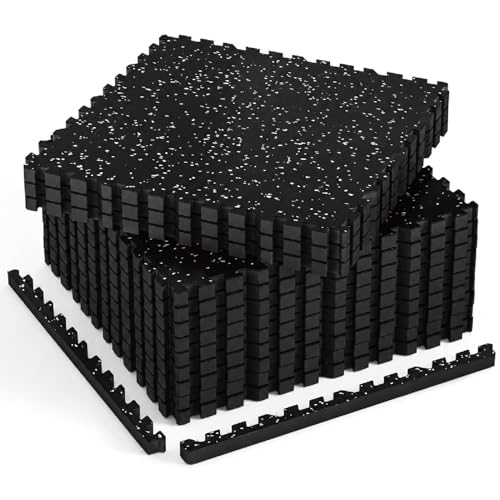
2. AIRHOP 1-Inch Ultra-Thick Rubber-Top Gym Tiles, 48 Square Feet — Best Premium
 Check On The Amazon.com
Disclosure: As an Amazon Associate, I earn from qualifying purchases.
| Fit | Custom fit for the models listed in this guide |
| Material | Rubber, all-weather and wipeable |
✅ Reasons to buy
- One full inch of rubber-top build is the threshold where dropped plates stop being a subfloor worry
- The deep core spreads impact across each tile, and the tall lock stems resist shifts under rack feet
- Noise and vibration also drop, which matters in shared houses and upstairs rooms
❌ Reasons to avoid
- Choose this floor for a dedicated lifting corner, a power rack, or regular plate work
- Higher price than basic entry-level alternatives
One full inch of rubber-top build is the threshold where dropped plates stop being a subfloor worry. The deep core spreads impact across each tile, and the tall lock stems resist shifts under rack feet.
Noise and vibration also drop, which matters in shared houses and upstairs rooms. Fit and coverage follow the details shown in the table, so choose the row that matches your space before you order.
3. ProsourceFit Puzzle Exercise Mat, 144 Square Feet — Best Large Foam Zone
 Check On The Amazon.com
Disclosure: As an Amazon Associate, I earn from qualifying purchases.
| Fit | Custom fit for the models listed in this guide |
| Material | Rubber, all-weather and wipeable |
✅ Reasons to buy
- One box of ProsourceFit puzzle mats floors 144 square feet, which covers a whole spare room in a single afternoon
- Half-inch EVA foam feels kind under knees during planks, stretching, and floor circuits
- Border pieces finish the edges cleanly, so the room looks planned rather than patched
❌ Reasons to avoid
- Border pieces finish the edges cleanly, so the room looks planned rather than patched
- Higher price than basic entry-level alternatives
One box of ProsourceFit puzzle mats floors 144 square feet, which covers a whole spare room in a single afternoon. Half-inch EVA foam feels kind under knees during planks, stretching, and floor circuits. Border pieces finish the edges cleanly, so the room looks planned rather than patched.
Weights are the boundary here, since pure foam remembers where dumbbells rested and dents over time. Keep heavy dumbbells on a rack tray or a small rubber island beside the foam zone. For bodyweight training, cardio, and stretch work, this large-format set remains the default right answer.
4. Haulcove 18-Piece EVA Foam Floor Tiles, 18 Square Feet — Best Budget Starter
 Check On The Amazon.com
Disclosure: As an Amazon Associate, I earn from qualifying purchases.
| Fit | Custom fit for the models listed in this guide |
| Material | Durable all-weather material, easy to clean |
✅ Reasons to buy
- Haulcove offers a real interlocking floor in a small 18-piece set covering 18 square feet
- The 12.6-inch tiles reach corners and narrow strips where large 24-inch tiles waste space
- Extra sets click into the same pattern, so a starter corner can grow into a full room over time
❌ Reasons to avoid
- At 0.4 inches thick, this is a stretch and movement floor rather than a weight floor
- Higher price than basic entry-level alternatives
Haulcove offers a real interlocking floor in a small 18-piece set covering 18 square feet. The 12.6-inch tiles reach corners and narrow strips where large 24-inch tiles waste space. Extra sets click into the same pattern, so a starter corner can grow into a full room over time.
At 0.4 inches thick, this is a stretch and movement floor rather than a weight floor. More seams per square foot need aligning, so take time pressing each joint flat during assembly. For testing whether a home gym habit sticks, this set keeps the first step small and simple.
5. AIRHOP 0.79-Inch Rubber-Top Gym Tiles, 48 Square Feet — Best Mid-Thick All-Rounder
 Check On The Amazon.com
Disclosure: As an Amazon Associate, I earn from qualifying purchases.
| Fit | Custom fit for the models listed in this guide |
| Material | Durable all-weather material, easy to clean |
✅ Reasons to buy
- The 0.79-inch AIRHOP tiles sit between the half-inch all-rounders and the full-inch lifting floor
- Depth forgives knees and occasional drops, while firmness keeps treadmill feet and rack feet from wandering
- A black and white checker pattern also hides seams that plain floors announce
❌ Reasons to avoid
- A black and white checker pattern also hides seams that plain floors announce
- Higher price than basic entry-level alternatives
5. AIRHOP 0.79-Inch Rubber-Top Gym Tiles, 48 Square Feet — Best Mid-Thick All-Rounder Build quality and fit match the models listed in the table above.
Fit and coverage follow the details shown in the table, so choose the row that matches your space before you order.
Buying Guide
Match Thickness to Training
Thickness maps to impact, so start from the heaviest thing that will hit the floor. Stretch and yoga need only 0.4 to 0.5 inches, while mixed training with moderate weights wants just over half an inch. Regular dumbbell work earns three-quarters of an inch, and racks with dropping plates earn the full inch.
Thicker is not always better, since deep foam wobbles under treadmills and standing equipment. Equipment zones want firmness first, while impact zones want depth first, and rubber-top hybrids sell both traits in one tile. Buy the bracket your training actually uses, not the thickest tile on instinct.
Rubber, Foam, or Hybrid
Pure rubber wins weight rooms because it resists dents, grips well, and outlives most equipment. Pure foam wins stretch and bodyweight rooms because joint comfort matters more than dent memory there. Rubber-top hybrids win mixed rooms by placing wear resistance where weights land and cushion underneath.
Buy by what actually happens on the floor rather than the loudest review or the thickest tile. If nothing drops except bodies, foam is honest value for the room. If iron drops regularly, rubber earns its place, and if both share the calendar, the hybrid ends the debate.
The Concrete Moisture Trap
Concrete slabs breathe vapour continuously, and tight-laid flooring can trap that moisture against both surfaces. Tiles may cup over time, and a dark, damp layer underneath can grow mould unseen. Run the plastic-sheet test first by taping clear plastic to the slab for a day and checking for condensation.
A failed test does not kill the plan, since loose-laid tiles lifted weekly for air can still work well. A proper subfloor layer also breaks the moisture path and keeps the gym healthy long term. Our basement floor covering guide covers damp-room choices in more depth for below-grade gyms.
Measure the Room Before Ordering
Measure wall to wall, then subtract fixed obstacles like doors, radiators, and built-in storage. Coverage per box decides how many boxes the room needs, so round up rather than ordering exactly to the edge. Spare tiles also cover future damage, since single-tile replacement beats relaying a whole floor.
Check door swing clearance against the chosen thickness before the delivery arrives at your home. Thick tiles raise transitions, so plan border strips or ramps where the gym meets the hallway. A quick dry layout of one row also reveals awkward cuts before any tile locks permanently.
Locks, Seams, and Layout
Interlocking tiles beat rolls for spare rooms because no adhesive and no full-room commitment are involved. Single damaged tiles can be replaced, and the whole floor can move when the room changes purpose. Lock quality decides daily comfort, since shallow puzzle stems open under lateral foot drag.
Stagger seams like brickwork so no four corners meet in one cross. Keep border strips for doorway edges, clean the locks before assembly, and press the finished floor firmly with body weight. A short hair-dryer pass flattens transit curl before heavy equipment rolls across the new floor.
Cleaning and Long-Term Care
Vacuum gym tiles with a hard-floor setting, since beater bars can catch seams and lift edges over time. Damp-mop rubber tops with mild cleaner, and wipe foam tiles before sweat dries into the surface. Lift a few tiles monthly in damp rooms to check the slab beneath stays dry.
Rotate high-traffic tiles occasionally so wear spreads evenly across the room rather than denting one lane. Keep heavy equipment on mats or trays where possible, since static feet compress foam over months. Replace single worn tiles promptly, because one lifted edge can trip a tired athlete mid-workout.
Frequently Asked Questions
Is rubber or foam better for a home gym?
Rubber suits anything with weights, while foam suits bodyweight and stretch work in the same room. Rubber-top EVA hybrids suit mixed rooms because they combine a tough surface with a forgiving core. Let the training decide, not the material reputation alone.
Can I put gym tiles directly on concrete?
Yes, after the plastic-sheet moisture test passes and the slab reads dry underneath. A damp slab warps foam and grows mould under tight-laid tiles over time. Failed tests call for loose-laid tiles lifted weekly or a subfloor layer beneath the gym floor.
What thickness do I need for weights?
Three-quarters of an inch upward suits regular dumbbell work in a home gym. Full-inch builds suit racks and plates that drop, since depth spreads impact and protects the subfloor. Below half an inch, foam floors keep dumbbell dents as long-term memory.
Do interlocking foam tiles dent under treadmills?
Under static feet, foam compresses over months, which is why equipment zones want high-density or rubber-top builds. An inexpensive equipment mat on top of the tiles solves most pressure points quickly. Rotate the mat occasionally so one spot never carries the full load alone.
How do I stop gym tiles from separating?
Stagger the seams, clean the locks before assembly, and press the joined floor firmly with body weight. Separation usually traces to debris in the joint or to four corners meeting in a cross. Curl settles with a hair-dryer pass followed by firm pressing across the whole floor.
Are EVA foam gym floors safe?
Quality EVA from respected brands is formamide-free and low-odour, so airing the room for a day is a normal step. Buy from makers who state their testing clearly, and keep uncertified mats out of children’s play zones. Replace any mat with a strong chemical smell that survives a full day of airing.
Conclusion
Let the training write the order for your room, with rubber where weights land and foam where bodies flow. Rubber-top hybrids cover mixed rooms, thickness follows impact, and the plastic-sheet test on concrete decides the rest of the install. Interlocking tiles forgive future changes, which is why they beat rolls for spare-room gyms.
Start with one zone done well rather than flooring a whole room with the wrong material. Measure the room, test the slab, and order the bracket your training actually needs. For larger garage-scale platforms, our garage floor mats guide extends this advice upward in size.


