


Home gym flooring fails by mismatch more than by quality. A yoga setup dies under a barbell, while a foam floor built for HIIT compresses permanently under a treadmill’s feet. The floor has to match the training, and the slab beneath it decides whether the whole system stays flat or grows a mould problem nobody sees.
Five floors are compared here by training style and construction. Rubber-top EVA tiles carry weights without denting, and a one-inch build serves heavy racks. A big-format foam set floors bodyweight zones, while a budget tile starts starter gyms. Thickness, top layer, and lock design did the sorting.
Below the picks, the guide settles the rubber-versus-foam argument per training style. It explains why interlocking builds beat rolls for spare rooms, then exposes the concrete moisture trap most guides skip. Hardwood subfloors have their own rules; our gym flooring over hardwood guide covers that pairing.
Quick Verdict
Best Overall: SUPERJARE 0.56″ Rubber-Top Gym Tiles, 48 sq ft — high-density EVA with a rubber work surface
Best for Heavy Weights: AIRHOP 1″ Ultra-Thick Rubber-Top Tiles — the deepest cushion and load spread for racks
Best Large Foam Zone: ProsourceFit Puzzle Mat, 144 sq ft — one purchase floors a whole stretch-and-cardio room
Best Budget Starter: Haulcove EVA Tiles, 18-piece — a real interlocking floor at a token price
Best Mid-Thick All-Rounder: AIRHOP 0.79″ Rubber-Top Tiles — the balance point between comfort and stability
Quick Comparison Table
| Product | Award | Key Spec | Check Price |
|---|---|---|---|
| SUPERJARE 0.56″ Rubber Top Gym Flooring, 48 sq ft, 12 Tiles | Best Overall | Rubber-top EVA interlocking tiles, 24 x 24 in, high-density core, 48 sq ft | Check Price on Amazon |
| AIRHOP 1″ Ultra-Thick Rubber Top Gym Flooring, 48 sq ft | Best for Heavy Weights | 1-inch rubber-top EVA interlocking tiles, floor and equipment protection | Check Price on Amazon |
| ProsourceFit Puzzle Exercise Mat, 1/2″ EVA, 144 sq ft | Best Large Foam Zone | 1/2-inch EVA interlocking foam tiles, 36 tiles, 144 sq ft, black | Check Price on Amazon |
| Haulcove 18-Piece EVA Foam Floor Tiles, 18 sq ft | Best Budget Starter | 12.6 x 12.6 in interlocking EVA tiles, 0.4 in thick, 18 sq ft | Check Price on Amazon |
| AIRHOP 0.79″ Rubber Top Gym Flooring, 48 sq ft | Best Mid-Thick All-Rounder | 0.79-inch rubber-top EVA tiles, black and white checker, heavy workout | Check Price on Amazon |
The Picks
1. SUPERJARE 0.56″ Rubber Top Gym Flooring, 48 sq ft, 12 Tiles — Best Overall
 Check On The Amazon.com
Disclosure: As an Amazon Associate, I earn from qualifying purchases.
| Thickness | 0.56 in |
| Surface | Rubber top |
| Core | High-density EVA |
| Coverage | 48 sq ft |
| Tile size | 24 x 24 in |
| Best for | Mixed training rooms |
✅ Reasons to buy
- Rubber skin resists dumbbell dents that pure foam remembers
- EVA core spares joints during jumps and standing work
- 24-inch tiles re-lock after a room re-arrangement
❌ Reasons to avoid
- Border strips needed under a half-inch lip at doorways
- Rubber-top seams show vacuum lines if cleaned wrong
The rubber-top hybrid exists because both materials alone fail somewhere: foam dents under weights, full rubber costs a fortune and slopes the room. SUPERJARE puts the wear layer where the damage happens and the cushion beneath it, which is the architecture most home gyms actually need.
At just over half an inch it suits cardio, dumbbells, and moderate barbell work alike. Rack-heavy lifters should step to the one-inch pick below; everyone else has found the balance point.
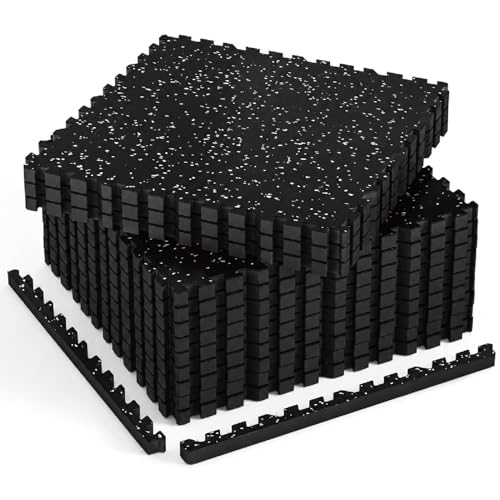
2. AIRHOP 1″ Ultra-Thick Rubber Top Gym Flooring, 48 sq ft — Best for Heavy Weights
 Check On The Amazon.com
Disclosure: As an Amazon Associate, I earn from qualifying purchases.
| Thickness | 1 inch |
| Surface | Rubber top |
| Core | High-density EVA |
| Coverage | 48 sq ft |
| Load | Rack and plate work |
| Best for | Heavy weight training |
✅ Reasons to buy
- Full-inch depth cushions dropped weights and protects subfloors
- Tallest joint stem of the group locks tiles against racking shifts
- Deadens clank and vibration through the slab below
❌ Reasons to avoid
- Thickest build raises door clearances and transitions
- Premium pricing per square foot of the list
Anything that drops from a rack wants depth, and one inch is the threshold where subfloor protection stops being theoretical. The tall core spreads plate impacts instead of denting, and neighbours hear less of the clank through the structure. For a dedicated lifting corner, this is the floor that makes the room legal in spirit.
Door clearance and price are the honest costs, so measure door swings before ordering. The height premium is the honest price of real load capacity in a floating format.
3. ProsourceFit Puzzle Exercise Mat, 1/2″ EVA, 144 sq ft — Best Large Foam Zone
 Check On The Amazon.com
Disclosure: As an Amazon Associate, I earn from qualifying purchases.
| Thickness | 1/2 in |
| Surface | EVA foam |
| Coverage | 144 sq ft |
| Tiles | 36, with borders |
| Use | Bodyweight and cardio |
| Best for | Whole-room floor zones |
✅ Reasons to buy
- One box covers a full spare-room gym wall to wall
- Foam comfort excels for floor work, stretching and yoga
- Twelve-year-proven puzzle format with endless spare-tile supply
❌ Reasons to avoid
- Pure foam remembers where dumbbells rested and dents
- Sheds squeaks against treadmill feet without an equipment mat
For bodyweight training, HIIT, and stretch zones, the classic 144-square-foot puzzle set remains the value king: one purchase, one afternoon, whole room floored. The half-inch EVA is kind to knees in plank and mountain-climber work where rubber can feel dead.
Weights are its boundary, not its weakness: keep dumbbells on a rack tray or a small rubber island, because foam holds their memory forever. As the floor of a general fitness room, it remains the default right answer.
4. Haulcove 18-Piece EVA Foam Floor Tiles, 18 sq ft — Best Budget Starter
 Check On The Amazon.com
Disclosure: As an Amazon Associate, I earn from qualifying purchases.
| Thickness | 0.4 in |
| Surface | EVA foam |
| Coverage | 18 sq ft |
| Tiles | 18 small-format |
| Use | Light training zones |
| Best for | Starter and corner gyms |
✅ Reasons to buy
- The cheapest real interlocking floor in the category
- Small tiles fill awkward corners big 24-inch tiles cannot
- Expandable set by set as the gym grows
❌ Reasons to avoid
- Thin build is a stretch-zone floor, not a weight floor
- More seams per square foot to keep aligned
Testing whether a home gym survives its first month is the honest use case, and this eighteen-square-foot set costs less than most pricing mistakes. Small tiles reach the corner behind the door that big formats waste, and every later box clicks into the same pattern.
It is a floor for movement, not for dropped iron; treat it accordingly and it serves the starter phase well. Growth then means growing the floor alongside the equipment.
5. AIRHOP 0.79″ Rubber Top Gym Flooring, 48 sq ft — Best Mid-Thick All-Rounder
 Check On The Amazon.com
Disclosure: As an Amazon Associate, I earn from qualifying purchases.
| Thickness | 0.79 in |
| Surface | Rubber top |
| Core | High-density EVA |
| Coverage | 48 sq ft |
| Pattern | Black and white |
| Best for | Comfort-stability balance |
✅ Reasons to buy
- Three-quarter-inch depth absorbs drops the half-inch layers dent under
- Stays flat under standing desk and treadmill feet better than soft foam
- Checker pattern hides seams that grey floors announce
❌ Reasons to avoid
- Between-size thickness suits many, perfect for few
- Black-and-white look is a statement in neutral rooms
The 0.79-inch bracket is where jump-heavy conditioning and moderate barbell work finally share a floor. Depth forgives knees and occasional drops, while firmness keeps equipment feet from wandering. The black-and-white checker pattern doubles as the room’s design feature.
For a household split between HIIT circuits and a growing dumbbell rack, this middle build avoids buying twice. Pure lifters still earn more from the one-inch pick above.
How We Chose
Flooring was sorted by construction before brand: pure EVA foam, rubber-top hybrids, and thickness brackets from 0.4 to 1.0 inch. The training each floor survives decided its slot, because a stretch-zone winner and a rack-zone winner fail each other’s tests by design.
Lock design, surface hardness, and seam behaviour were scored as daily realities: tiles that shift under treadmill feet or open seams under racking were rejected. Coverage per purchase, border-strip supply, and the honest weight limits each maker states completed the ranking.
Rubber, Foam, or Rubber-Top Hybrid
The materials argument ends when training enters it. Pure rubber wins for weight rooms: it does not dent, it grips, and it outlives the equipment. Pure foam wins for stretching, yoga and bodyweight circuits, where joint comfort outranks dent memory. The rubber-top hybrid takes the mixed room, putting wear resistance where dumbbells land and cushion beneath.
Buy by what actually happens on the floor, not the loudest review. If nothing drops but bodies, foam is honest value; if iron drops, rubber earns it; if both share the calendar, the hybrid ends the debate.
The Concrete Moisture Trap
Foam and rubber read as waterproof, which is how finished basements grow silent mould fields beneath them. Concrete slabs breathe vapour continuously, and closed-cell flooring laid tight traps that moisture against both surfaces. The tiles cup, and the slab stays dark underneath. The plastic-sheet test tapes down fact in one day.
A failed test does not kill the plan; it changes it. Interlocking tiles laid loose, lifted weekly for air, or installed over a proper subfloor layer keep both the gym and the slab healthy. Basement questions continue in our basement floor covering guide.
Thickness by Training Style
Thickness maps to impact. The 0.4 to 0.5 inch band serves stretching, yoga and light circuits, while just over half an inch carries mixed training with moderate weights. Three-quarters of an inch takes conditioning plus regular dumbbell work, and the full inch exists for racks, plates and drops. Matching the bracket beats buying the thickest tile on instinct.
Thicker is not universally better, because deep foam wobbles under treadmill and standing work. Equipment zones want firmness; impact zones want depth. The hybrid tops exist to sell both traits in one tile.
Locks, Seams and the Interlocking Advantage
Interlocking tiles beat rolls for spare rooms one rerrangement at a time: no adhesive, no full-room commitment, and single-tile replacement when damage happens. Lock quality decides everything, since a shallow puzzle stem opens under lateral foot drag and leaves a trip lip mid-workout.
Stagger the seams like brickwork so no four corners meet, keep border strips for doorway edges, and de-contact the tiles before heavy equipment rolls across. A hair-dryer pass flattens transit curl, and pressing the finished floor with body weight closes the last lazy seams.
Frequently Asked Questions
Is rubber or foam better for a home gym?
Rubber for anything with weights, foam for bodyweight and stretch work, and rubber-top EVA hybrids for mixed rooms. The training decides, not the material’s general reputation.
Can I put gym tiles directly on concrete?
Yes, after the plastic-sheet moisture test passes; a damp slab warps foam and grows mould under tight-laid tiles. Failed tests want loose-laid tiles lifted weekly or a subfloor layer beneath.
What thickness gym flooring do I need for weights?
Three-quarters of an inch upward for regular dumbbell work, and the full inch where plates drop. Below half an inch, foam floors keep the dents as long-term memory.
Do interlocking foam tiles dent under treadmill or equipment?
Under static feet they compress over months, which is why equipment zones want high-density or rubber-top builds. An inexpensive equipment mat on top of the tiles solves the pressure points.
How do I stop gym tiles from separating?
Stagger the seams, clean the locks before assembly, and press the joined floor firmly. Separating usually traces to debris in the joint or to corners meeting in a cross. Curl settles with a hair-dryer pass and body-weight pressing.
Are EVA foam gym floors safe and non-toxic?
Quality EVA is formamide-free and odour-low at respected brands, so airing the room for a day is a normal step. buy from makers who state their testing, and keep uncertified mats out of kids’ play zones.
📐 Free Tool: Flooring Calculator
Enter your room size — see exactly how many boxes you need, waste included.
Conclusion
Let the training write the order: rubber where weights land, foam where bodies flow, and the rubber-top hybrid where both share a room. Match the thickness bracket to the impact, and the plastic-sheet test on concrete decides the rest of the install.
Interlocking tiles forgive every future decision the room makes, which is why they beat every roll for spare-room gyms. For garage-scale platforms and vehicle-proof surfaces, the garage floor mats guide extends this page upward in size.


